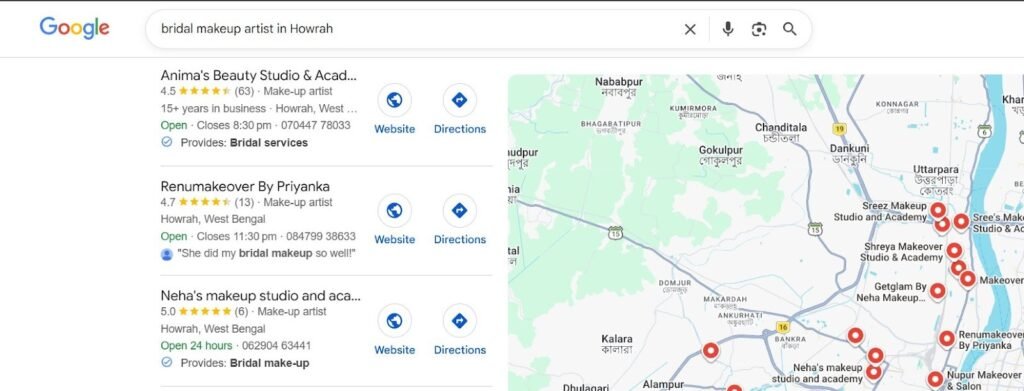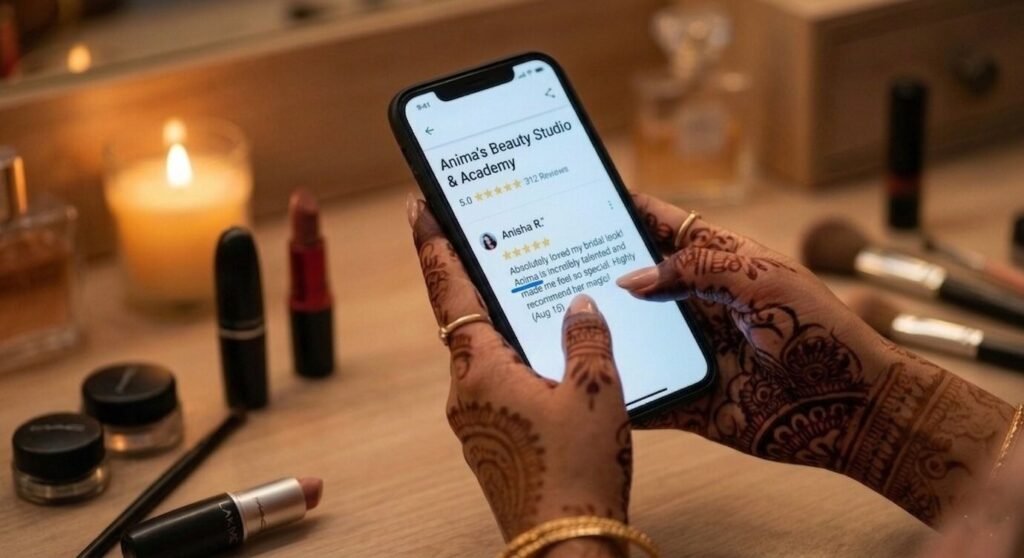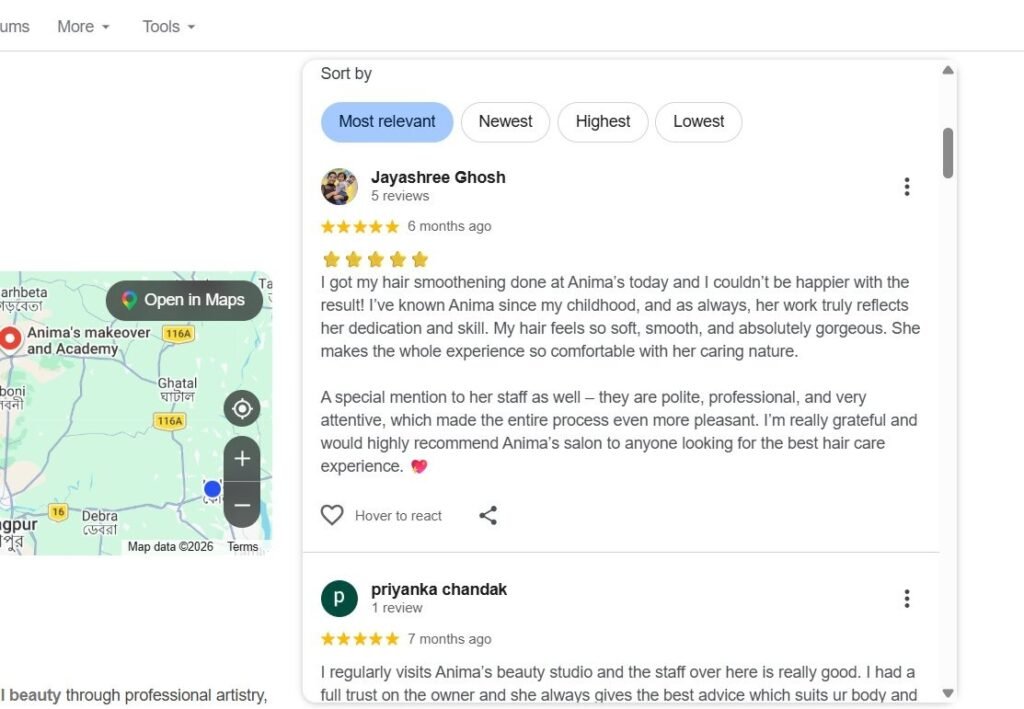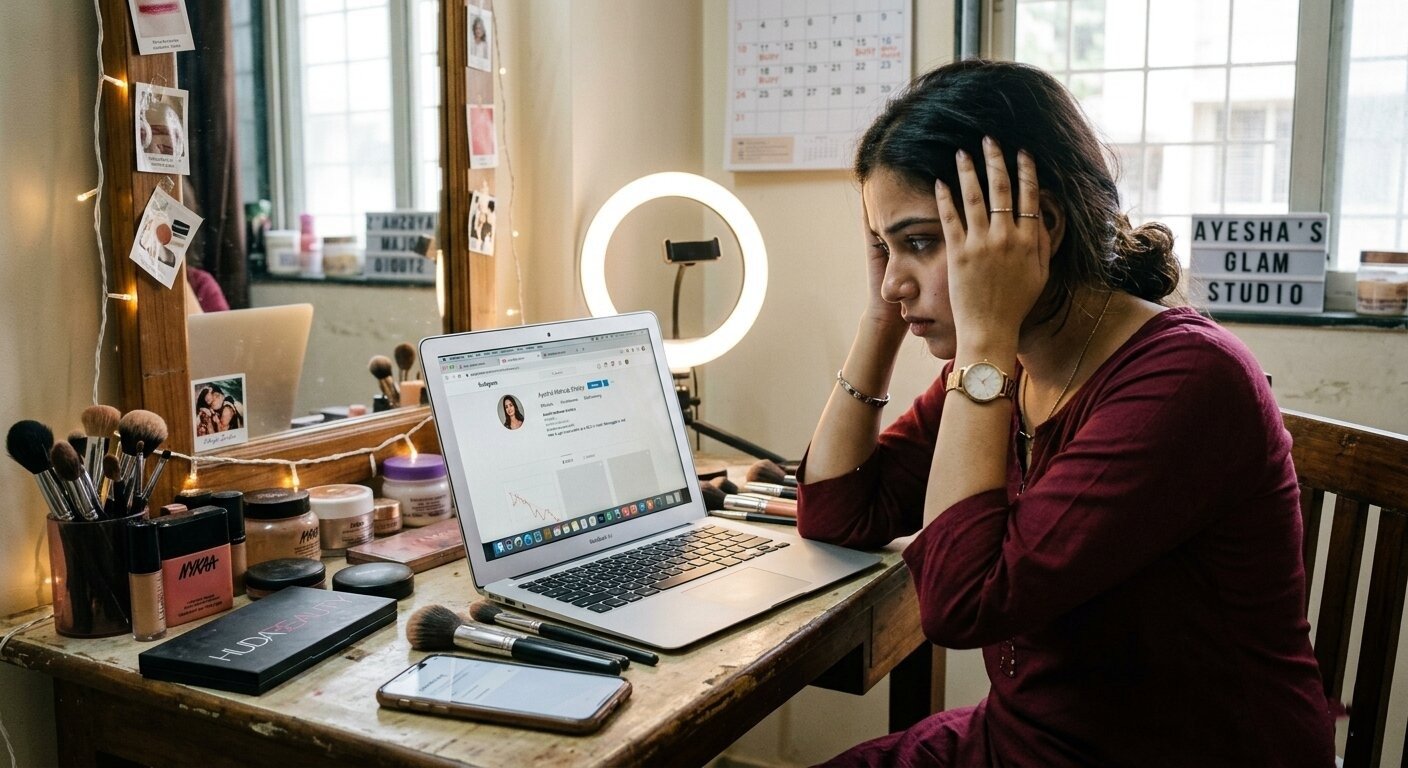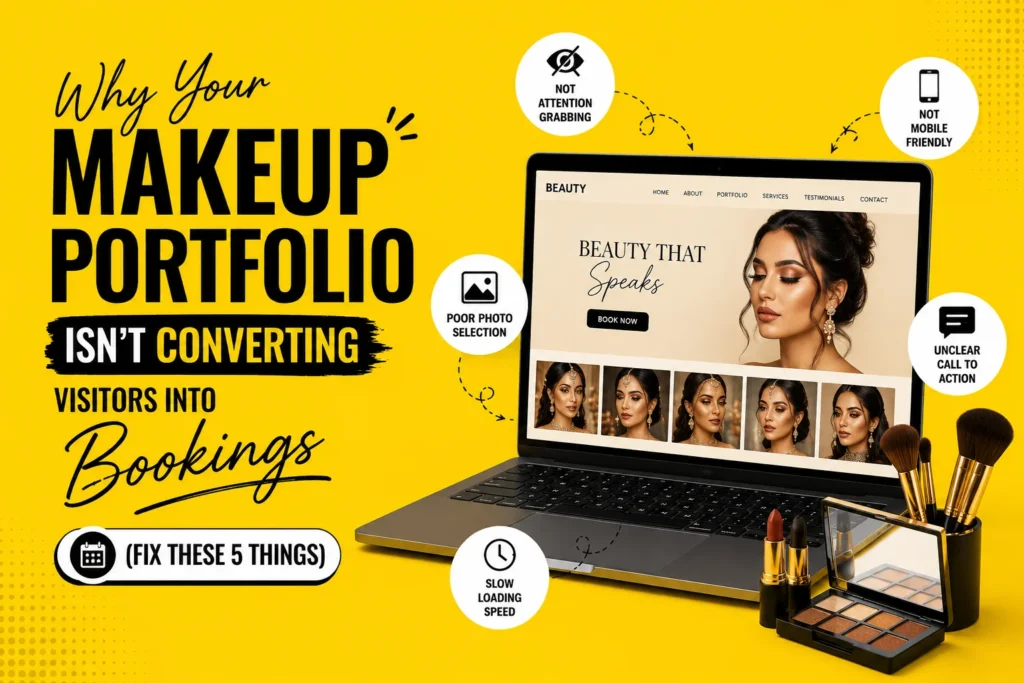
You set up your Google Business Profile months ago. You filled in your business name, added a few photos, and maybe even wrote a short description. And yet — your phone isn’t ringing. If you’ve been searching for why your makeup artist profile isn’t getting clients from Google Business Profile, you’re not imagining things. The profile is there. It’s just not working.
A lot of makeup artists feel the same way. You wonder why your makeup business isn’t visible on Google Maps even though competitors seem to appear effortlessly. You start questioning whether Google even works for freelance artists like you. It does — but having a profile is only the starting point.
The truth is, Google doesn’t rank every profile equally. It ranks profiles that give it enough signals to trust and recommend. If yours is missing those signals, Google simply won’t show it — no matter how talented you are.
In this post, we’re going to diagnose exactly what’s going wrong — and give you a fix for each problem.
What you’ll learn:
Why an incomplete or inactive profile fails to rank on Google Maps
The category and service mistakes that make Google misunderstand your business
Why reviews are more important than most makeup artists realise
How your location signals (or lack of them) affect your visibility
Why getting found and getting booked are two completely different problems
Having a Google Business Profile isn’t enough — here’s why
Google uses three core signals to decide which local businesses to show in search results and on Google Maps: Relevance, Proximity, and Prominence. These three factors — known as the relevance-proximity-prominence model — determine whether your profile appears when a potential client searches nearby.
Relevance means Google understands what you do and matches you to the right searches. Proximity means Google believes you’re physically close to the person searching. Prominence means Google sees enough trust signals — reviews, activity, citations — to consider you a credible option.
A weak or incomplete profile fails all three. Google can’t categorise you correctly, can’t place you confidently on the map, and sees no evidence that anyone trusts your business.
According to Google, businesses with complete profiles are 2.7 times more likely to be considered reputable by consumers. That single statistic explains why so many talented makeup artists are invisible online — not because they lack skill, but because their profile is giving Google almost nothing to work with.
The rest of this post breaks down six root causes of a failing profile. Think of it as a diagnostic checklist — read each one and ask yourself honestly whether it applies to you.
→ Related read: Why Most Makeup Artists Struggle to Get Clients Online in India (And How to Fix It)
Root cause #1 — Google doesn’t know what you actually do
One of the most common Google Business Profile mistakes for makeup artists is choosing the wrong primary category — or leaving secondary categories completely blank. If your profile is listed as a “Beauty salon” or “Hair salon” instead of “Make-up artist”, Google is trying to match you to the wrong searches entirely.
Your primary category is the single most important signal you give Google about your business type. It directly influences which searches you’re eligible to appear in. If it’s wrong, no amount of photos or posts will fix your visibility.
Missing services make the problem worse. If you haven’t listed your actual offerings — bridal makeup, editorial looks, special occasion packages — Google has no service signals to connect your profile to client searches like “bridal makeup artist near me” or “prom makeup in [city]”.
The fix: Change your primary category to “Make-up artist” immediately. Add relevant secondary categories such as “Beauty salon”, “Bridal shop”, or “Wedding service”. Then go into the Services section and list every single service you offer, with descriptions. The more specific, the better.
⚡ Quick fix: Change your primary category to “Make-up artist” right now — not “Beauty salon”, not “Nail salon”. Then add at least three secondary categories and list every service you provide. This alone can move your profile up in local results within weeks.
Root cause #2 — your profile looks abandoned to Google
Google Business Profile isn’t a set-it-and-forget-it tool. It’s a living signal. When you stop posting, stop responding to reviews, and let your photos go stale for months, Google reads that inactivity as a sign that your business may no longer be active — or simply not worth surfacing.
This is one of the key reasons a Google Business Profile stops generating leads. Low engagement tells Google that either clients aren’t interested in your profile, or you’re not invested in maintaining it. Either way, it pushes your listing down in favour of profiles that show consistent activity.
Google business profile engagement matters more than most people realise. Every post you publish, every review you respond to, every question you answer in the Q&A section — these are trust signals. They tell Google that a real, active business is behind this profile.
Think of it like a social media algorithm: the more you feed it, the more it shows you.
The fix: Commit to posting on your GBP at least once a week — a recent look, a client result, a seasonal promotion. Respond to every single review within 48 hours. Check your Q&A section and answer any pending questions.
⚡ Quick fix: Set a recurring reminder every Monday to publish one GBP post. It doesn’t need to be long — a photo with two sentences is enough. Consistent activity over 60 days will meaningfully improve how Google perceives your profile.
Root cause #3 — you have no reviews, or the wrong ones
If you’re wondering why your makeup artist profile isn’t getting reviews on Google, you’re not alone — and it’s one of the biggest ranking obstacles you’ll face. Zero reviews or just one or two means Google doesn’t have enough social proof to trust your profile. It simply won’t take the risk of recommending a business that nobody has publicly vouched for.
The stakes are high. According to data from Womply, businesses with 200 or more reviews generate roughly twice the revenue of those with fewer than five. You don’t need 200 reviews to start ranking — but you need more than three.
There’s a second layer to this too. Reviews that contain no relevant keywords pass less ranking signal to Google. A review that says “Amazing! 10/10” is nice — but a review that mentions “bridal makeup in East London” or “airbrush foundation for wedding” gives Google searchable, location-specific content to associate with your profile.
Take Priya, a bridal makeup artist based in South London. She had four five-star reviews but was still invisible in local searches. Once she started specifically asking clients to mention their service type, occasion, and location in reviews, she moved into the Google Map Pack within three months — without changing anything else.
The fix: After every booking, send a follow-up message with your Google review link and a short prompt. Ask clients to mention the type of makeup they had, the occasion, and their area. Make it easy — paste the link directly into a WhatsApp message.
⚡ Quick fix: Create a simple review request template you can send after every job. Include your direct Google review link, and ask clients to mention your service, the occasion, and the area. Aim to collect at least two new reviews per month.
Root cause #4 — Google can’t place you on the map
If your makeup business isn’t visible on Google Maps, and your makeup studio isn’t ranking locally, the problem is often a location signal issue — not a quality issue.
Google’s proximity signal means it tries to show businesses that are physically close to the person searching. If it can’t confidently determine where you’re located or which areas you serve, it won’t include you in local results. This is a particularly common problem for mobile makeup artists who hide their home address. If you’ve hidden your address without setting a service area, Google has nowhere to put you on the map.
NAP consistency — meaning your business Name, Address, and Phone number match exactly across every directory, social media profile, and website — also plays a role. Even small discrepancies like “St.” vs “Street” can confuse Google’s location matching.
The fix: Set a clear service area in your GBP settings — list the cities, boroughs, or counties you cover. Make sure your NAP details are identical across your website, Facebook, Instagram bio, and any local directories. If you have a website, embed a Google Map on your contact page.
⚡ Quick fix: Log into your GBP right now and check your service area settings. If you’re a mobile artist with a hidden address, you must set a service area or you’ll be invisible in map searches. Add every area you work in, not just your home location.
Root cause #5 — your competitors are playing the game, you’re not
When clients search for makeup artists near them, the profiles that appear in the Google Map Pack aren’t always the most talented artists in the area. They’re the ones giving Google the most signals. That’s why competitors rank higher on Google Maps — not because they’re better at their craft, but because they’ve given Google more reasons to trust them.
This isn’t a reason to feel disheartened. It’s actually good news: you can close the gap with effort, not talent.
Do a quick five-minute competitor audit. Search for a makeup artist in your area. Click on the top three profiles. Check how many reviews they have, how many photos, how recently they last posted, and whether their services are listed. You’ll almost certainly find they have more of each of these than you do.
The fix: Use what you find as your benchmark. If the top-ranking profile has 40 reviews, that’s your immediate target. If they post weekly, that’s your new standard. You’re not copying them — you’re identifying the signals Google is rewarding and matching them.
→ Go deeper: Local SEO Strategy for Makeup Artists in India: Get Found on Google Without Ads — includes a step-by-step competitor profile audit.
Root cause #6 — your profile gets views but doesn’t convert
Here’s a scenario that catches a lot of makeup artists off guard: your profile is actually getting impressions and views — but nobody is calling or booking. This is the visibility vs. conversion problem, and it’s separate from ranking entirely.
A Google Business Profile that isn’t generating leads despite decent views usually has a conversion problem, not a visibility problem. People are finding you — they’re just not choosing you.
The most common culprits are: no booking link (so clients have to figure out how to contact you), no prices or service descriptions (so they can’t make a decision), and poor or too few photos (so they don’t feel confident enough to reach out). Being found is not the same as being chosen.
Think about what a potential client sees when they click your profile. Is there a button to book instantly? Can they see prices? Do they see 10+ photos that make them feel excited to work with you? If not, you’re losing bookings to competitors whose profiles answer those questions before the client even has to ask.
The fix: Add a booking link directly to your GBP (use your booking platform or a Calendly link). Write service descriptions with clear pricing where possible. Upload at least 10 strong portfolio photos. Write a business description that speaks directly to your ideal client — what occasions you specialise in, what makes your work distinctive.
⚡ Quick fix: Add a booking link to your GBP today — it takes two minutes and immediately removes the biggest friction point between a viewer and a booking. Then add at least five more portfolio photos this week.
Is your Google Business Profile making these mistakes?
Run through this quick diagnostic. If you answer “no” or “I’m not sure” to any of these, that’s a root cause worth fixing today.
Are you using “Make-up artist” as your primary category — not “Beauty salon” or “Hair salon”?
Have you listed at least three secondary categories relevant to your work?
Have you added your services with descriptions in the Services section?
Have you posted on your GBP within the last seven days?
Have you responded to every review you’ve ever received — including the most recent ones?
Do you have five or more Google reviews that mention specific services, occasions, or locations?
Have you set a service area (especially if you’re a mobile artist with a hidden address)?
Is your business name, address, and phone number identical across every platform — website, Instagram, Facebook, directories?
Does your profile have a direct booking link?
Does your profile have at least 10 portfolio photos that showcase your best work?
Frequently asked questions
Does an incomplete Google Business Profile affect ranking?
Yes, directly. Google uses your profile to understand what you do, where you are, and whether you’re credible. Missing categories, no services, and sparse information all reduce your relevance and prominence scores — two of the three signals Google uses to rank local profiles. An incomplete profile is one of the most common and fixable reasons makeup artists don’t appear in local searches.
Why do my competitors rank above me on Google Maps?
In almost every case, competitors ranking above you have more reviews, more photos, complete service listings, and a more active posting history. Google’s algorithm rewards profiles that provide more signals of trust and relevance. This is not about the quality of their makeup work — it’s about the quality of their Google Business Profile signals.
How long does it take to rank on Google Maps?
There’s no fixed timeline, but most makeup artists who fix their core issues — categories, service area, reviews, and activity — start to see movement in local rankings within four to twelve weeks. Review velocity matters: gaining two to three new reviews per month consistently will accelerate your results faster than any one-off change.
Do I need a physical address to rank on Google Maps?
No. Mobile makeup artists can rank without displaying a home address by setting a service area instead. However, if you’ve hidden your address and haven’t set a service area, Google has no location to associate with your profile — which means you’ll be invisible in map-based searches. Set your service area to every area you work in.
How many reviews do I need to show up in the Google Map Pack?
There’s no official threshold, but in competitive local markets, you’ll typically need at least 10 to 15 reviews to have a realistic chance of appearing in the Map Pack — the three profiles shown in local search results. The quality and keyword content of those reviews matters too. Reviews that mention your services and location give Google more searchable signals to work with than generic star ratings.
Start with one fix today
Your Google Business Profile isn’t working because Google doesn’t yet have enough signals to trust or rank you. That’s the whole diagnosis in one sentence. It’s not about your skill. It’s not about your location. It’s about the information you’ve given — or not given — to Google.
If you only have time to tackle three things, make them these: fix your categories (10 minutes), ask your last five clients for a review today (5 minutes), and post something on your GBP this week (10 minutes). These three actions target relevance, prominence, and activity — the core of what Google is looking for.
Start with root cause #1 today — it takes 10 minutes and it’s completely free. Then work through the checklist above, one section at a time.
Walk through the busy streets of Kolkata, and you’ll quickly realize that business is not just an activity here—it’s a way of life. From crowded markets to towering corporate offices, the city breathes commerce. Behind much of this energy is a community that quietly but powerfully shaped its economic backbone—the Marwadis.
Originally from Rajasthan, Marwadis didn’t just come to Kolkata to do business—they built systems, relationships, and legacies that still define how trade works in the city today.
A Journey Driven by Opportunity
The story begins centuries ago, when Kolkata was rising as a major trading hub under the British East India Company. For many Marwadi families living in the harsh, dry regions of Rajasthan, this presented a rare opportunity.
Imagine leaving your home, traveling across the country with limited resources, and starting from scratch in a completely new environment. That’s exactly what many Marwadis did. They began as small traders, moneylenders, and middlemen—taking risks, building trust, and slowly carving a space for themselves in an unfamiliar city.
What set them apart wasn’t just business skill—it was patience and persistence.
Burrabazar: Where It All Came Together
If you want to truly understand Marwadi influence in Kolkata, spend a day in Burrabazar. It’s chaotic, loud, and endlessly busy—but beneath that chaos lies a deeply organized system built over generations.
Here, business isn’t done with flashy presentations or complex contracts. It runs on trust, relationships, and reputation. Deals are often sealed with a handshake, and a person’s word carries weight.
Many Marwadi families started with tiny shops in Burrabazar. Over time, those small setups grew into large trading houses. What’s fascinating is how these businesses stayed within families, with knowledge passed from one generation to the next—almost like a living classroom of entrepreneurship.
From Small Traders to Industry Leaders
Not every story stayed small. Some Marwadi entrepreneurs went on to build massive business empires that shaped not just Kolkata, but all of India.
Take Ghanshyam Das Birla, for example. Starting from humble beginnings, he went on to create one of India’s biggest industrial groups. His journey reflects a larger pattern—thinking big, even when starting small.
Similarly, leaders like R.P. Goenka expanded into diverse industries, from power to retail. Their businesses created jobs, boosted infrastructure, and helped position Kolkata as a serious economic powerhouse.
These weren’t just businessmen—they were builders of modern industry.
A Different Way of Doing Business
One of the most interesting aspects of Marwadi success is how they approach money and finance.
Long before modern banking became widespread, they relied on systems like “hundi”—a trust-based method of transferring money. It worked because relationships mattered more than paperwork.
Even today, many Marwadi businesses operate on core principles like:
Spend carefully
Save consistently
Reinvest wisely
Think long-term
It’s simple advice, but incredibly powerful—and it’s one of the reasons their businesses have survived for generations.
Beyond Profit: Giving Back to the City
What often goes unnoticed is how much the Marwadi community has given back to Kolkata. Their success wasn’t just about building wealth—it was also about creating impact.
Across the city, many schools, hospitals, and charitable institutions have been supported by Marwadi families. This sense of responsibility comes from a belief that business success should benefit society as well.
Over time, they didn’t just live in Kolkata—they became a part of its social and cultural fabric.
The New Generation: Blending Tradition with Change
Today, things are changing—but not disappearing.
Younger Marwadis in Kolkata are stepping beyond traditional businesses. Many are entering startups, tech companies, finance, and even global markets. They’re more experimental, more digital, and more open to new ideas.
But here’s the interesting part—they still carry the same core values: discipline, resilience, and a strong business mindset.
It’s this balance between tradition and innovation that keeps the community relevant even today.
The story of Marwadis in Kolkata isn’t just about business—it’s about courage, adaptation, and long-term thinking.
They arrived as outsiders, started small, faced challenges, and slowly built something extraordinary. Today, their influence is everywhere—from local markets to large corporations.
Kolkata’s business landscape wouldn’t be what it is without them. And perhaps the biggest lesson they leave behind is this: success isn’t built overnight—it’s built over generations, with trust, discipline, and vision.
Kolkata, once the capital of British India, was far more than an administrative center—it was the intellectual and revolutionary heartbeat of the Indian freedom movement. The city gave rise to thinkers, leaders, and fearless revolutionaries who challenged colonial rule through ideas, action, and sacrifice.
From political leadership to armed rebellion, the freedom fighters associated with Kolkata played a defining role in India’s struggle for independence. Their stories are not just historical accounts—they are powerful reminders of courage and conviction.
The Rise of Revolutionary Spirit in Kolkata
Kolkata became a center of resistance due to its strong educational institutions, vibrant press, and politically aware youth. The city fostered both intellectual debate and underground revolutionary movements.
Secret societies, student activism, and nationalist writings created an atmosphere where resistance against British rule became inevitable. It was in this charged environment that some of India’s greatest freedom fighters emerged.
Subhas Chandra Bose: The Face of Bold Nationalism
One of the most influential leaders of the freedom movement, Subhas Chandra Bose had a deep connection with Kolkata. His early education in the city exposed him to nationalist ideas that shaped his future path.
Unlike many leaders, Bose believed that independence required direct and forceful action. As the leader of the Indian National Army (INA), he sought to overthrow British rule through military means. His famous call, “Give me blood, and I will give you freedom,” inspired millions across the country.
Kolkata was not just his hometown—it was the foundation of his revolutionary ideology.
Aurobindo Ghosh: The Intellectual Force Behind Nationalism
Before becoming a spiritual philosopher, Aurobindo Ghosh was one of the strongest voices of early nationalism. During his time in Kolkata, he actively participated in revolutionary activities and used journalism as a powerful tool to awaken political consciousness.
Through his writings in nationalist newspapers, he advocated complete independence at a time when many leaders were still seeking reforms under British rule. His contribution highlights how ideas and intellect played a crucial role in shaping the freedom movement.
Youth Revolutionaries: Khudiram Bose and Prafulla Chaki
The courage of Bengal’s youth became a defining feature of the freedom struggle. Khudiram Bose and Prafulla Chaki symbolize this fearless spirit.
Their attempt to assassinate a British official in 1908 marked one of the earliest revolutionary actions against colonial rule. Although the mission did not succeed as planned, Khudiram’s execution at just 18 years old turned him into a national hero.
His bravery demonstrated that even the youngest citizens were ready to sacrifice their lives for independence.
The Writers’ Building Attack: A Symbol of Defiance
One of the most dramatic events in Kolkata’s revolutionary history was the attack on the Writers’ Building—the center of British administration.
This bold act was carried out by:
Binoy Basu
Badal Gupta
Dinesh Gupta
Their mission was to challenge colonial authority directly. Though they ultimately sacrificed their lives, their actions sent a powerful message: the British were not invincible.
Chittaranjan Das: The Voice of Political Leadership
Not all freedom fighters chose the path of armed resistance. Chittaranjan Das, popularly known as Deshbandhu, represented the political and constitutional struggle for independence.
A respected lawyer and leader, he played a key role in the Non-Cooperation Movement and later founded the Swaraj Party. He also mentored Subhas Chandra Bose, guiding him in his early political journey.
Das believed in self-governance and worked tirelessly to unite people across communities in the fight against British rule.
Women in the Freedom Struggle: Matangini Hazra
The contribution of women in the freedom movement is often overlooked, but figures like Matangini Hazra prove otherwise.
Even in her seventies, she actively participated in protests during the Quit India Movement. She was shot while leading a procession but continued chanting “Vande Mataram” until her last breath.
Her story reflects the inclusive nature of the struggle, where courage knew no boundaries of age or gender.
Rash Behari Bose: The Global Revolutionary
Rash Behari Bose extended the influence of Bengal’s revolutionary movement beyond India. Though much of his work took place abroad, his roots were deeply connected to Bengal’s political climate.
He played a crucial role in organizing revolutionary networks and later contributed to the formation of the Indian National Army, which was eventually led by Subhas Chandra Bose.
His efforts highlight the international dimension of India’s fight for independence.
Why Kolkata Became a Hub of Freedom Fighters
Kolkata’s unique combination of intellectual culture and political awareness made it a breeding ground for revolutionaries.
This dynamic environment allowed multiple forms of resistance to grow simultaneously.
A Legacy of Courage and Sacrifice
The freedom fighters associated with Kolkata were more than historical figures—they were symbols of resistance, determination, and vision.
From the militant leadership of Subhas Chandra Bose to the intellectual influence of Aurobindo Ghosh, from the youthful bravery of Khudiram Bose to the political wisdom of Chittaranjan Das, each contributed uniquely to India’s independence.
Their legacy continues to inspire generations, reminding us that freedom was not granted—it was earned through immense sacrifice.
Kolkata remains a living testament to this legacy—a city where revolution was not just an act, but a way of life.
Kolkata isn’t just a city you visit—it’s a city you feel. And nowhere is that feeling more alive than in its markets. Here, shopping isn’t just about buying things; it’s about the sounds, the chaos, the bargaining, and those unexpected finds you didn’t even know you needed.
Whether you love street shopping or prefer a more relaxed experience, Kolkata has something waiting for you.
New Market – Where It All Begins
If you want a true taste of Kolkata shopping, New Market is the place to start. It’s old, crowded, a little chaotic—and that’s exactly why people love it.
You’ll find almost everything here, from clothes and bags to cosmetics and food items. Walking through its narrow lanes feels like stepping into a different time. And yes, bargaining is part of the game. During festivals, the entire place lights up and becomes even more vibrant.
Gariahat Market – The Street Shopping Vibe
Gariahat is where the real street shopping magic happens. Stalls line the roads, shopkeepers call out to you, and there’s always something interesting to catch your eye.
It’s especially popular for sarees—both traditional and modern. But that’s not all. You’ll find trendy clothes, jewelry, and everyday essentials at prices that make you want to buy more. If you enjoy bargaining, this place will be fun.
College Street – A Place for Book Lovers
College Street feels different from the rest. It’s quieter in its own way, but full of stories—literally.
Rows of bookstalls stretch as far as you can see, filled with everything from textbooks to rare novels. There’s something special about picking up an old book here, flipping through its pages, and finding a hidden gem. Even if you’re not a regular reader, this place has a charm you can’t ignore.
Dakshinapan Shopping Complex – Calm and Cultural
If you want a break from the crowds, Dakshinapan offers a more peaceful experience. It’s neat, organized, and full of traditional items.
You’ll find handloom sarees, handcrafted jewelry, and decor pieces from different parts of India. It’s the kind of place where you take your time, look around, and pick something meaningful.
Hatibagan Market – Budget Shopping Done Right
Hatibagan is where locals go when they want good things at reasonable prices. It’s simple, practical, and full of options.
Whether you’re looking for daily wear or something for a special occasion, you’ll find it here without spending too much. It may not be fancy, but it gets the job done—and does it well.
Burrabazar – Fast, Busy, and Full of Energy
Burrabazar is not for the faint-hearted. It’s crowded, noisy, and always moving—but that’s what makes it exciting.
This is where business happens. From textiles to spices, everything is available in bulk at great prices. It might feel overwhelming at first, but once you get used to it, you’ll see why it’s such an important part of Kolkata.
Quest Mall – A Different Side of Shopping
If you’re in the mood for something calm and modern, Quest Mall offers a completely different experience. Clean spaces, well-known brands, and a relaxed environment make it perfect for a slow shopping day.
It’s not as chaotic as the markets, but sometimes that’s exactly what you need.
Final Thoughts
Shopping in Kolkata is not just about what you buy—it’s about what you experience along the way. Every market has its own personality, its own rhythm.
Some places are loud and energetic, others are calm and quiet. But each one adds something special to your journey.
So when you’re in Kolkata, don’t rush. Take your time, explore these markets, and enjoy the little moments. Because here, shopping is never just shopping—it’s a story you take back with you.
Let’s be honest—running a sports academy today is very different from what it was a few years ago.
Earlier, word-of-mouth, banners, and local connections were enough to fill your batches. But in 2026, things have changed. Now, before joining any academy, parents and students do one thing first—they go online.
They search, compare, check reviews, watch videos, and then decide.
So the real question is: if your academy isn’t visible online, do you even exist for them?
The Way People Find Academies Has Changed
Think about your own behavior.
If you’re looking for something—anything—you probably search on Google or scroll through social media. Your potential students are doing the exact same thing.
They’re searching things like:
“Best cricket academy near me”
“Football coaching for kids”
“Swimming classes in my area”
And within seconds, they have multiple options in front of them.
If your academy doesn’t show up there, you’re simply missing out—no matter how good your coaching is.
More Visibility = More Enrollments
At the end of the day, every academy wants more students. That’s where digital marketing makes a real difference.
It’s not just about being online—it’s about being seen by the right people at the right time.
With the right strategy, you can:
Get regular enquiries
Fill your batches faster
Promote new programs easily
And the best part? You don’t have to wait months. Digital marketing can start bringing leads in a very short time if done correctly.
Your Audience is Already Online
Parents, teenagers, and young athletes spend hours every day on their phones—especially on social media.
They’re scrolling, watching reels, checking videos, and discovering new things constantly.
That means your academy has a huge opportunity to show up in their daily feed.
If you’re posting:
Training clips
Student progress videos
Match highlights
You’re not just promoting—you’re building interest and trust without directly selling.
Social Media Builds Trust Before They Visit You
Here’s something important—people don’t trust ads instantly. But they do trust consistency.
When someone sees your academy regularly posting content, they start feeling familiar with your brand.
They think: “Okay, this academy looks active.” “The coaching seems good.” “Students are improving here.”
By the time they contact you, half the convincing is already done.
That’s the power of social media in 2026—it’s not just marketing, it’s relationship building.
Video Content is a Game-Changer
If you’re not using video yet, you’re missing a huge opportunity.
People love watching real action—especially in sports. A short clip of a training session or a student transformation can say more than a long description ever could.
Simple videos like:
Before/after training progress
Coaching sessions
Tournament moments
can grab attention instantly.
And sometimes, just one good video can bring in hundreds of enquiries.
Local Visibility Matters More Than Ever
Most sports academies depend on nearby students. No one wants to travel too far daily for practice.
That’s why showing up in local searches is extremely important.
When someone searches for an academy in your area, you want your name to appear at the top.
This is where digital marketing helps you:
Rank locally
Get discovered easily
Build trust through reviews
Because let’s be real—people trust an academy more when they see good ratings and real feedback.
Paid Ads Can Boost Your Growth Fast
If you want faster results, paid ads are a great option.
You can target exactly who you want:
Parents of kids
Teen athletes
People in your local area
And promote:
New batches
Summer camps
Free trial sessions
This kind of targeted promotion was never possible with traditional marketing.
Now, you’re not wasting money—you’re reaching the right audience directly.
You Can Actually Track What’s Working
One of the biggest advantages of digital marketing is clarity.
You don’t have to guess anymore.
You can clearly see:
How many people saw your ad
How many clicked
How many contacted you
This helps you improve continuously and spend smarter.
Competition is Growing Fast
More sports academies are opening every year. And many of them are already using digital marketing.
So even if your coaching is better, if they’re more visible online—they’ll attract more students.
That’s the reality.
In 2026, visibility often beats quality in the first step. Of course, quality matters—but only after people find you.
Building a Strong Brand is No Longer Optional
Today, people don’t just join academies—they join brands they trust.
Your academy needs an identity:
What makes you different?
Why should someone choose you?
Digital marketing helps you answer these questions clearly and consistently.
And if you want to scale faster, working with the best digital marketing agency can help you build a strong and professional presence without trial and error.
Final Thoughts
Digital marketing is no longer an “extra” for sports academies—it’s essential.
It helps you get discovered, build trust, attract students, and grow consistently.
The academies that adapt to this shift will keep growing.
The ones that don’t… will slowly struggle to keep up.
Because in today’s world, the real competition doesn’t just happen on the field—it starts online.
Digital marketing for makeup artists is the systematic use of Google Business Profile, Instagram, and WhatsApp to generate consistent bridal and event booking enquiries online. In India, it combines local SEO for map-pack visibility, portfolio-led social content for discovery, and WhatsApp-based closing funnels to convert online attention into real appointments. A makeup artist with a complete digital foundation can expect first organic enquiries within 4–8 weeks and 20–40 monthly leads within 90 days — without spending on ads.
Quick Answer
The 5 channels that drive bookings for makeup artists in India:
Google Ads — high-intent capture for brides actively searching to book
Meta Ads — paid reach once your foundation is ready
Most artists see their first organic enquiries within 60 days of setting up the free foundation. Paid ads should only start after you have 10+ portfolio posts and 3+ Google reviews — without this, ad spend does not convert.
If you’re a makeup artist in India, you already know this frustration.
You’re talented. Your work gets compliments. Brides love your makeup when they sit in your chair. But your calendar? Still not full.
Meanwhile, someone less skilled is fully booked months in advance.
That’s not luck — that’s visibility.
In 2026, being a great artist is not enough. If brides across Kolkata and nearby areas like Howrah, Salt Lake, New Town, or even Durgapur can’t find you online, they won’t book you.
This guide walks you through digital marketing for makeup artists step by step — in plain language, built specifically for the Indian market.
You’ll learn:
How brides actually find makeup artists today
How to promote your makeup business online
What to post on Instagram (and what actually works)
How to get clients as a makeup artist consistently
When to use paid ads — and when not to
Why Most Talented Makeup Artists Struggle to Get Clients Online
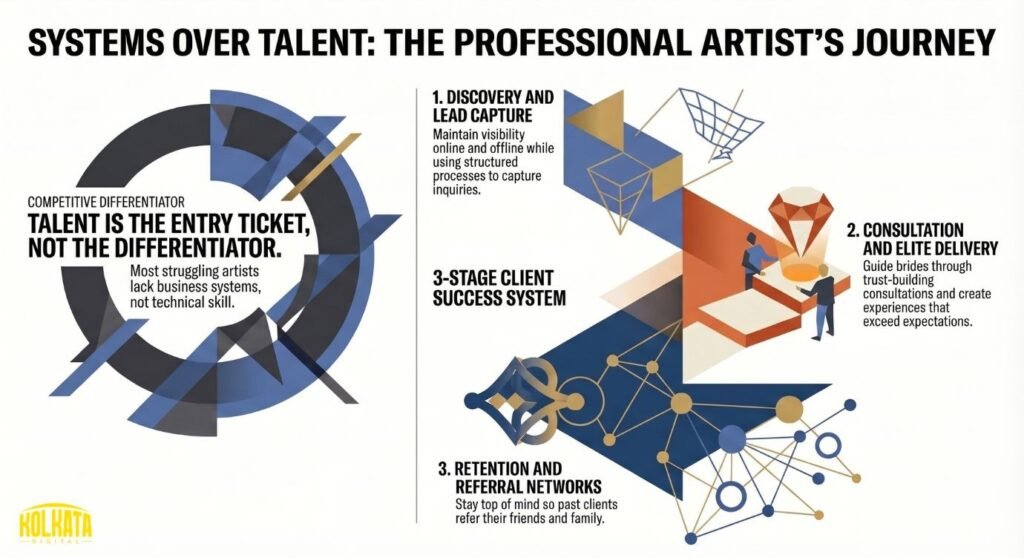
Most talented makeup artists struggle to get clients online because skill and visibility are two different things — brides book who they can find, not necessarily who is best.
Let’s be honest.
India has thousands of incredibly talented makeup artists — but only a small percentage are consistently booked.
Why?
Because talent ≠ visibility.
Here’s the real problem:
Brides don’t search for “best skills”
They search for what they can see
And what they see online becomes their “best option”
The Gap Between Skill and Visibility
Most makeup artists:
Don’t show their work consistently
Don’t optimise their profiles
Rely only on Instagram posts
Don’t appear on Google
So even if you’re amazing, you’re invisible online.
What Has Changed in 2026
Today:
Brides research 5–10 artists before booking
They check Instagram, Google, and reviews
They shortlist based on online presence, not just talent
If you’re not showing up consistently, you’re losing clients — not because you’re not good, but because you’re not visible.
How Brides in India Actually Find Their Makeup Artist
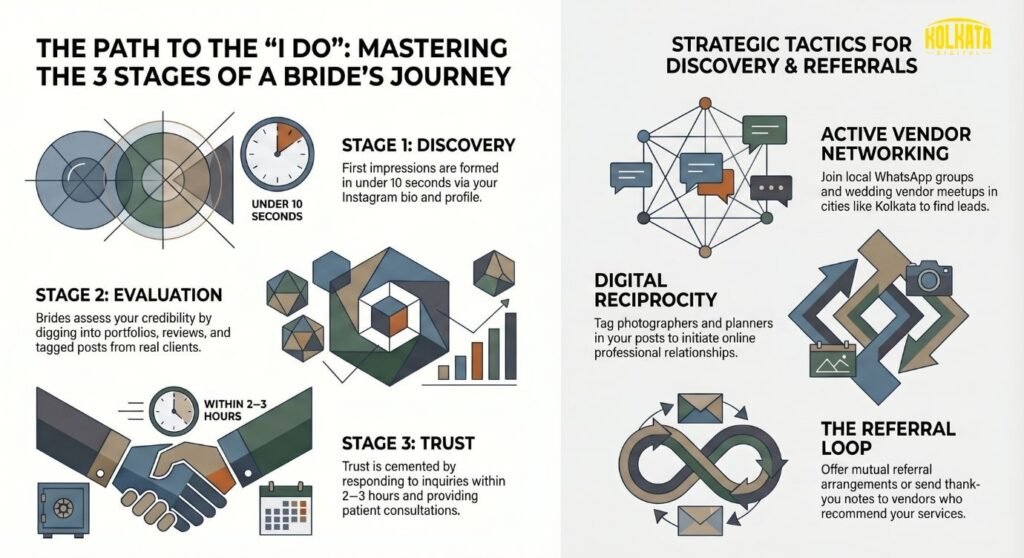
Brides in India find their makeup artist through three primary channels: Google search (“bridal makeup artist near me”), Instagram Reels and hashtags, and referrals from photographers or friends — in that order of booking intent.
Before you market yourself, you need to understand how brides think.
But even here, they still check your Instagram before booking.
4. Wedding Platforms
WedMeGood
ShaadiSaga
WeddingWire
These platforms help, but they are competitive and expensive.
Reality Check
If you’re not visible on:
Google
Instagram
WhatsApp
You are missing 80% of potential clients.
Platform
Monthly cost
Best for
Reach
Conversion
Effort
When to start
Instagram
Organic
₹0
Portfolio & discovery
Brides browse and save your work here
★★★★★
★★★★★
High
Day 1 — 4 posts/week minimum.
Instagram
Paid Ads
₹3,000–10,000
Lead generation
Reach brides who don’t follow you yet
★★★★★
★★★★★
Medium
Month 3 — after 10+ portfolio posts and 3+ reviews.
Google
Business Profile
₹0
Local search ranking
Highest intent traffic of all channels
★★★★★
★★★★★
Low
Week 1 — highest ROI per hour of any channel.
Google Ads
Search
₹3,000–7,000
High-intent leads
Brides actively searching to book right now
★★★★★
★★★★★
Medium
Month 3 — only with 5+ Google reviews.
WhatsApp
Business
₹0
Booking conversion
Where enquiries become actual bookings
★★★★★
★★★★★
Low
Week 1 — every channel should funnel here to close.
WedMeGood
Free listing
₹0
Bridal discovery
High purchase intent browsers
★★★★★
★★★★★
Low
Month 1 Week 4 — with 20+ photos minimum.
WedMeGood
Paid listing
₹2,000–4,000
Warm lead volume
Top placement in city search
★★★★★
★★★★★
Very low
Month 2 — upgrade once profile has 10+ reviews.
Blog / SEO
Your website
₹0
Long-term organic traffic
Compounds over time, no ad spend needed
★★★★★
★★★★★
High
Month 2 — results take 3–6 months but compound.
The Digital Marketing Foundation for Makeup Artists
Before running any ads or focusing on Instagram growth, every makeup artist needs four things in place: a verified Google Business Profile, a WhatsApp Business account, a portfolio of at least 10 real client photos, and 3+ Google reviews.
Before you spend time or money, you need the basics right.
Think of this as your digital setup.
1. Google Business Profile (MOST IMPORTANT)
This helps you show up when someone searches: “makeup artist near me”
You must:
Add your services (Bridal, Engagement, Party)
Upload real photos
Collect reviews
2. Basic Website or Landing Page
Even a simple page works.
Include:
Portfolio
Pricing (or starting price)
Location
Contact button
3. Strong Portfolio
Not just pretty photos — but:
Different skin tones
Different looks
Close-ups
4. WhatsApp Business Setup
This is where most bookings happen in India.
Set up:
Auto-reply
Catalogue (your services)
Quick replies
Golden Rule
Don’t run ads or focus on Instagram until this foundation is ready.
Otherwise, you’ll get enquiries — but no conversions.
A step-by-step guide to setting up your digital marketing foundation as a makeup artist in India.
Set up Google Business Profile
Create or claim your Google Business Profile. Add your business name under the category Makeup Artist, phone number, service area, and upload at least 10 real portfolio photos. Verify via phone or postcard.
Set up WhatsApp Business
Download WhatsApp Business and set up a greeting message, away message, and 5 quick reply templates covering pricing, availability, portfolio link, booking confirmation, and thank you.
Optimise your Instagram profile
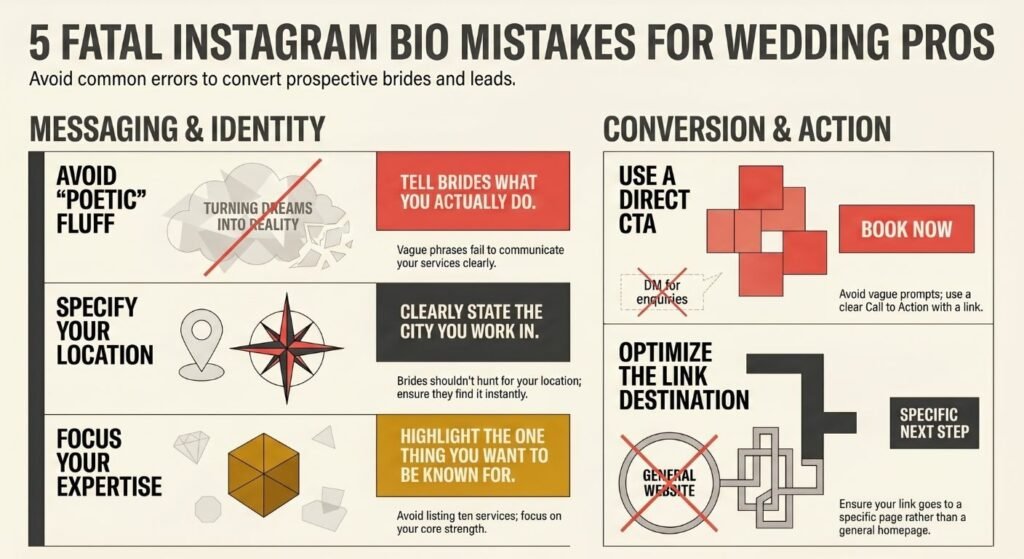
Rewrite your bio in this format: What you do | City | Specialty | WhatsApp CTA. Create 3 Highlights labelled Portfolio, Reviews, and Pricing. Commit to 4 posts per week.
Collect your first Google reviews
Ask your last 5 clients for a Google review via WhatsApp. Send your direct Google review link with a short message. Get at least 3 reviews before spending on paid ads.
Create a free WedMeGood listing
Set up a free profile on WedMeGood with at least 20 photos, your service categories, starting price, and WhatsApp contact. Ask 2-3 past brides to leave reviews there too.
Instagram Marketing for Makeup Artists
Instagram is the primary discovery platform for makeup artists in India — Reels drive reach to new audiences while portfolio posts build the trust that converts profile visitors into WhatsApp enquiries.
Instagram is your digital showroom.
But most artists use it incorrectly.
What to Post
Focus on:
Before & after transformations
Close-up skin shots
Bridal looks
Client reactions
Reels vs Static Posts
Reels = Reach (new audience)
Posts = Trust (portfolio)
You need both.
Bio Optimisation
Your bio should clearly say:
What you do
Where you are
How to contact you
Example: “Bridal Makeup Artist | Kolkata HD & Airbrush Specialist Book on WhatsApp.”
Converting Followers into Enquiries
Don’t just post.
Tell people what to do:
“DM to book.”
“WhatsApp for pricing”
👉 Read our complete guide on Instagram Growth Strategy for Makeup Artists to learn this step by step. 👉 Also check the Instagram Reels Strategy to understand what type of content actually goes viral.
Local SEO — How to Appear on Google When Brides Search Near You
Local SEO gets makeup artists into Google’s map pack — the three listings that appear when brides search “makeup artist near me” — and it consistently delivers higher booking intent than any social media channel.
This is the most underrated strategy in makeup artist marketing in India.
Content marketing and blogging help makeup artists rank on Google for questions brides search before booking, such as “HD vs airbrush makeup” or “how to choose a bridal makeup artist” — building organic traffic that compounds over time without ad spend.
This is your long-term growth strategy.
It takes time — but brings consistent clients.
Why It Works
Brides search things like:
“HD vs Airbrush makeup”
“How to choose a bridal makeup artist”
If you answer these — they find YOU.
What to Write About
Bridal tips
Skin prep guides
Makeup trends in India
Real bride stories
Benefits
Builds trust
Improves Google ranking
Brings organic enquiries
This is a powerful part of online marketing for makeup artists in India, especially if you want long-term growth.
Paid Ads — Facebook, Instagram, and Google Ads
Paid ads work for makeup artists only after the foundation is ready — a portfolio, reviews, and a WhatsApp number in the bio. Without these, ads generate clicks but not bookings.
Your 90-Day Digital Marketing Roadmap as a Makeup Artist
This 90-day roadmap builds your digital marketing in the correct order — free foundation first, then consistency, then paid amplification — so that when ad spend is added in Month 3, the infrastructure is already converting.
Most makeup artists try everything at once and burn out in 3 weeks. This roadmap breaks it down into 3 focused months — so you build in the right order and see results without overwhelm.
Month 1 is entirely free. You don’t need to spend a single rupee on ads until Month 3. The reason most ads fail is not budget — it’s that the foundation wasn’t ready before the money was spent.
Month 1 Foundation
Month 2 Consistency
Month 3 Amplification
Month 1
Foundation — build before you promote
Goal: get your digital presence ready so every channel works together
Week 1 Google Business Profile + WhatsApp setup
G
Create or claim your Google Business Profile. Add business name, category (Beauty Salon / Makeup Artist), phone, location, and service area.
Takes 2–3 days to verify via postcard or phone
W
Set up WhatsApp Business. Write a greeting message, away message, and 5 quick replies (pricing, availability, portfolio link, booking confirmation, thank you).
📸
Upload 10–15 portfolio photos to GBP. Use real client photos — before/after, close-up skin, bridal looks. No stock images.
Week 2 Instagram profile optimisation
I
Rewrite your Instagram bio. Format: [What you do] | [City] | [Specialty] | [CTA with WhatsApp link]. Example: Bridal Makeup Artist | Kolkata | HD & Airbrush | Book via WhatsApp 👇
🎬
Film your first 3 Reels. One before/after transformation, one product flat-lay with trending audio, one “day in my life as a makeup artist.” No editing skills needed — phone + good lighting is enough.
📌
Create 3 Instagram Highlights. Label them: Portfolio / Reviews / Pricing. Pin your best content to each.
Week 3 Portfolio + first reviews
⭐
Ask your last 5 clients for a Google review. Send a WhatsApp message with your direct Google review link. Don’t ask on Instagram — Google reviews carry 10× more SEO weight.
Script: “Hi [name], thank you so much for trusting me for your [event]. If you have 2 minutes, a Google review would mean the world — here’s the link: [link]”
🗂
Organise your portfolio into 3 categories: Bridal, Party/Engagement, Editorial. This makes your work easier to browse and helps clients self-qualify.
Week 4 Local SEO + WedMeGood listing
🗺
Add your services to GBP with keyword-rich descriptions. Example: “Bridal HD Makeup in Kolkata — includes skin prep, HD foundation, eye makeup, and setting spray.”
📋
Create a free WedMeGood profile. Add 20+ photos, your starting price, and ask 2–3 past brides to leave reviews there too.
📅
Plan your Month 2 content calendar. Map out 16 posts (4 per week): 2 Reels + 2 portfolio carousels each week. Batch-film on weekends.
Month 1 target: GBP live and verified · 3+ Google reviews · 10+ portfolio posts on Instagram · WhatsApp Business active · First 3 Reels published
Month 2
Consistency — show up every week without fail
Goal: first organic enquiries from Google and Instagram
Week 5–6 Content rhythm + hashtag strategy
🎬
Publish 2 Reels + 2 carousels every week, no exceptions. Reels go out Monday and Thursday. Carousels Tuesday and Saturday. Consistency matters more than perfection.
#
Use a 3-tier hashtag mix on every post: 5 broad (#bridalmakeup, #makeupartist), 5 mid (#kolkatabride, #bengalibride), 5 local (#bridalmakeupartistkolkata, #makeupartistkolkata). Save as a Notes template to paste quickly.
💬
Engage for 30 minutes after every post. Reply to comments, comment on 10 posts from wedding photographers and bridal stores in your city. This signals activity to the algorithm.
Week 6–7 Google ranking push
G
Post once a week on your Google Business Profile. Share a before/after photo with a caption like: “Bridal HD makeup done in Kolkata last weekend — book your trial today via WhatsApp.”
⭐
Collect 2 more Google reviews. Ask every client the day after their appointment while the experience is fresh. Target: 5 reviews by end of Month 2.
🔗
Reach out to 2 wedding photographers for a collab. Offer a free styled shoot in exchange for tagging you in their posts. One good photographer tag can bring 5–10 profile visits from brides.
Week 7–8 WhatsApp broadcast + referral launch
📲
Create a WhatsApp broadcast list of all past clients. Send one message: your availability for the next bridal season, your updated pricing, and a referral offer.
Referral offer example: “Refer a bride and get ₹500 off your next booking”
📖
Publish your first blog post. Topic: “HD vs Airbrush Makeup — Which is Better for Brides in Kolkata?” This targets a high-intent search query and builds long-term organic traffic.
Month 2 target: 4 posts/week maintained · 5+ Google reviews · First enquiries from Google Maps · 1 photographer collab locked in · Referral program live
Month 3
Amplification — add paid to what is already working
Goal: 20–40 enquiries/month, first paid ad leads
Week 9–10 Launch your first Meta Ad
▶
Boost your best-performing Reel as a paid ad. Pick the Reel with the most saves and shares. Set budget: ₹300/day. Target: Women aged 22–35, within 20 km of your city, interest: wedding planning, bridal makeup.
Run for 10 days first. If cost per DM is under ₹500, scale to ₹500/day.
📋
Create a dedicated bridal package landing post. A carousel: slide 1 = your best bridal look, slides 2–4 = what’s included, slide 5 = pricing range, slide 6 = “WhatsApp to book.” Run this as your second ad.
Week 10–11 Google Ads (optional but powerful)
G
Launch a Google Search campaign. Keywords: “bridal makeup artist Kolkata”, “HD makeup artist near me”, “best makeup artist for wedding Kolkata”. Budget: ₹200–300/day. Only run if you have 5+ Google reviews.
📞
Add a call extension and location extension to your Google Ad. Brides searching on mobile will call directly — this reduces friction and improves lead quality.
Week 11–12 Review, optimise, and plan Month 4+
📊
Review your numbers for the full 90 days. Track: Instagram followers gained, GBP views, WhatsApp enquiries, Google reviews, ad spend vs leads generated. Write these down — they become your baseline.
✂
Cut what is not working. If a content format gets no saves or shares after 8 posts, drop it. If an ad’s cost per lead is above ₹800, pause and rework the creative.
📅
Plan for the next bridal season. In India, peak bridal seasons are October–February and April–June. If Month 3 falls before a peak season, scale ad spend 2× starting 6 weeks before it begins.
Month 3 target: First paid ad leads at under ₹700 CPL · 20–40 total enquiries/month · 8+ Google reviews · 1,000+ Instagram followers · Referral bookings starting to come in
Makeup Artist Digital Marketing & Advertising Ideas in India
The most effective makeup artist advertising ideas in India combine free channels (referral programs, photographer collaborations, GBP posts) with low-budget paid formats (before-and-after Reels boosted for ₹200–500/day) rather than relying on expensive campaigns alone.
Running ads is one way to get clients.
But it’s not the only way — and for most makeup artists starting out, it’s not even the best way.
Here are the most effective makeup artist advertising ideas you can use right now, with or without a budget.
1. Referral Program — Your Cheapest Ad
Word of mouth already works for you.
Make it official.
Offer your existing clients:
₹300–₹500 off their next booking for every referral
A free touch-up session for 2 referrals
A discount on bridal trials for anyone who sends you a booking
Most makeup artists never do this — and it’s the easiest way to get warm leads fast.
2. Collaborate With Wedding Photographers
Wedding photographers work with 3–5 brides every weekend.
If they recommend you, those brides trust it instantly.
How to build this:
Offer a free shoot collaboration
Share each other’s work on Instagram
Add each other to your Google Business Profile descriptions
One good photographer relationship can bring you 10+ bookings a year.
3. Get Listed on WedMeGood and ShaadiSaga
Brides in India actively use these platforms to shortlist artists.
Even a free listing works — but a reviewed, photo-rich profile works much better.
What to do:
Create a complete profile with pricing range
Upload 15–20 photos (real brides, not stock)
Ask past clients to leave reviews there too
This is one of the most underused makeup artist advertising ideas in Kolkata.
4. Collaborate With Bridal Boutiques and Lehenga Stores
Think about it — when a bride buys her lehenga, her wedding is 2–3 months away.
She still needs a makeup artist.
Approach 2–3 local bridal stores and offer:
A printed card with your portfolio QR code they can hand to customers
A small referral discount for their clients
Cross-promotion on Instagram
This is offline advertising that costs almost nothing.
5. Google Business Profile Posts
Most makeup artists set up their Google profile — and then forget it.
Google lets you post updates directly to your profile, like:
Bridal season availability
New package launches
Behind-the-scenes photos
These posts show up when someone searches you on Google Maps. Posting once a week keeps your profile fresh and pushes you above inactive competitors.
6. Before-and-After Reels as Paid Ads
If you’re going to run ads — this is the format that converts.
A simple before-and-after video of a bridal client, boosted for ₹200–₹500 a day, targeted to:
Women aged 22–35
Location: your city + 20km radius
Interest: wedding planning, bridal makeup
This outperforms any static image ad, every time.
How much should a makeup artist spend on digital marketing in India?
A makeup artist in India should spend ₹0 on ads for the first 60 days, ₹3,000–5,000/month on Meta Ads once the foundation is ready, and only add Google Ads (₹3,000–7,000/month) after reaching 5+ Google reviews.
Stage 1 — Starting out
Stage 2 — Growing
Stage 3 — Scaling
₹0 – ₹5,000Monthly budget
0–6 monthsTypical stage
5–15Enquiries/month (target)
Channel
Monthly cost
What to do
Expected result
Free channels (do these first)
Google Business Profile Free
₹0
Set up completely — add services, upload 10+ real photos, collect your first 5 reviews
Takes ~2 hours to set up properly
Show up on “makeup artist near me” searches within 4–8 weeks
Instagram (organic) Free
₹0
4 posts/week — 2 Reels (reach) + 2 portfolio posts (trust). Add WhatsApp link in bio.
100–300 followers in 60 days if consistent
WhatsApp Business Free
₹0
Set auto-reply, create a services catalogue, save 5 quick-reply templates for enquiries
Converts enquiries 3× faster than DM-only
Optional paid (only after foundation is ready)
Meta Ads (boosting Reels) Paid
₹2,000–5,000
Boost your best before/after Reel. Target women aged 22–35, within 20 km, interest: wedding planning.
8–15 enquiries/month at ₹300–600 per lead
Stage 1 total
₹0 – ₹5,000/mo
Run free channels for 60 days first. Only spend on ads once you have 10+ portfolio photos and at least 3 Google reviews.
₹8,000 – ₹20,000Monthly budget
6–18 monthsTypical stage
20–40Enquiries/month (target)
Channel
Monthly cost
What to do
Expected result
Free channels (maintain)
Google Business Profile Free
₹0
Post weekly updates, respond to all reviews within 24 hrs, add new photos monthly
At this stage, track cost per booking (not just per lead). A ₹50,000 budget should yield ₹3–5L in bridal bookings — aim for 6–10× ROAS minimum.
Most makeup artists either spend nothing (and stay invisible) or jump straight to ads before their foundation is ready. Here’s a realistic budget framework based on where you are in your business.
Stage 1 — Starting out (₹0–₹5,000/month)
If you’re new to digital marketing, spend nothing on ads yet. Google Business Profile, Instagram, and WhatsApp Business are all free — and they should be your entire focus for the first 60 days. Only add Meta Ads (₹2,000–5,000/month) once you have at least 10 portfolio photos and 3 Google reviews. Without these, your ad spend will not convert.
Stage 2 — Growing (₹10,000–21,000/month)
Once you’re getting consistent organic enquiries, add Meta Ads (₹5,000–10,000), Google Ads (₹3,000–7,000), and a paid WedMeGood or ShaadiSaga listing (₹2,000–4,000). At this stage, you should be generating 20–40 enquiries per month. A reasonable cost per lead at Stage 2 is ₹400–700.
Stage 3 — Scaling (₹42,000–88,000/month)
At this stage you’re aiming for 50–100 enquiries per month. Your benchmark should be 6–10× ROAS — a ₹50,000 monthly budget should generate at least ₹3–5 lakh in bridal bookings. If it’s not, your creative or targeting needs fixing before scaling spend further.
The golden rule: Never run ads without a portfolio, reviews, and a WhatsApp number in your bio. Ads bring traffic — your foundation converts it.
WhatsApp Marketing — India’s Secret Weapon for Booking Clients
WhatsApp converts makeup artist enquiries into bookings faster than any other channel in India — an auto-reply, a pricing quick-reply, and a review request template are the three messages every artist needs set up before promoting anywhere else.
In India, WhatsApp converts better than email.
Why It Works
Instant communication
Personal connection
Easy booking
How to Use It
Create a simple funnel:
Instagram / Google
Click WhatsApp
Auto-reply
Share pricing & portfolio
Close booking
1
Auto-reply for new enquiries
Auto-reply
When to use: Set as your WhatsApp Business greeting message — sends automatically to anyone messaging you for the first time
Hi! 👋 Thank you for reaching out.
I’m [Your Name], a bridal & party makeup artist based in [City].
To help me assist you better, could you share:
• Date of your event?
• Type of makeup needed (bridal/party/engagement)?
• Your location?
I’ll get back to you within 2 hours with availability and pricing. 💄
💡 This reduces ghost enquiries by 60% — unserious leads drop off when asked for specifics
2
Pricing response
Quick reply
When to use: Save as a quick reply labelled “pricing” — send when a client asks how much you charge
Hi [Name]! 😊 Here’s a quick overview of my packages:
💍 *Bridal Makeup* — Starting ₹[X]
(includes trial session + wedding day)
✨ *Party / Engagement* — Starting ₹[X]
🏫 *Graduation / Shoot Makeup* — Starting ₹[X]
Prices vary based on look complexity and travel. I’d love to understand your vision better — shall we schedule a quick call or trial? 📞
💡 Never quote a single fixed price over WhatsApp. A range invites conversation; a fixed number kills it
3
Booking confirmation
Quick reply
When to use: Send immediately after a client confirms their booking and pays the advance
Hi [Name]! Your booking is confirmed 🎉
Here’s a summary:
📅 *Date:* [Date]
⏰ *Time:* [Time]
📍 *Location:* [Location]
💄 *Service:* [Service booked]
💰 *Advance paid:* ₹[Amount]
Please arrive with a clean, moisturised face and no eye makeup. I’ll send you a reminder 2 days before.
So excited to be part of your special day! 🌸
💡 The prep instructions reduce on-the-day issues and save 20 minutes per client
4
Google review request
Quick reply
When to use: Send within 24 hours of completing a client’s makeup — while the experience is fresh
Hi [Name]! So glad you loved your look today 💕
If you have 2 minutes, a Google review would genuinely mean the world to me — it helps other brides find me too.
Here’s the direct link (takes less than 60 seconds):
👉 [Your Google review link]
Thank you so much for trusting me! 🙏
💡 Get your direct Google review link from Google Business Profile > Ask for reviews > Copy link
5
Seasonal broadcast message
Broadcast
When to use: Send to your full client broadcast list 6–8 weeks before peak bridal season (October and April)
Hi [Name]! 👋
Wedding season is almost here and dates are filling up fast 🌸
If you or anyone you know is getting married between [Month] and [Month], I’d love to be part of it!
🎁 *Referral offer:* Refer a bride and get ₹500 off your next booking with me.
My calendar for [Season]:
✓ [Available dates]
✗ Already booked: [Blocked dates]
Reply here to check availability or book a trial 💄
💡 Showing blocked dates creates urgency — brides book faster when they see others have secured dates
👉 Learn step-by-step in WhatsApp Marketing Funnel for Makeup Artists
Branding — Why It Determines the Clients You Attract
Branding determines the type and price point of clients a makeup artist attracts — a clearly positioned soft-glam specialist commands higher fees and fewer price negotiations than a generalist with similar skill.
Branding is not just a logo.
It’s:
Your style
Your positioning
Your pricing perception
Example
Soft glam specialist → premium clients
Budget bridal → price-sensitive clients
What Good Branding Does
Attracts better clients
Increases pricing power
Builds trust
👉 Read our detailed guide on Branding Strategy for Makeup Artists
Common Digital Marketing Mistakes Makeup Artists Make in India
The most common digital marketing mistakes makeup artists make in India are posting inconsistent content without a niche focus, ignoring Google entirely, and running paid ads before having a portfolio and reviews in place.
Let’s fix the most common issues.
1. Posting Random Content
Many makeup artists post everything — party looks, reels, trends, random selfies — without a clear focus. This confuses potential bridal clients, and they don’t see you as a specialist they can trust for big occasions.
Fix: Stick to bridal-focused content. Focus your content around a specific niche like bridal makeup. Share before-after transformations, real client stories, and wedding looks to position yourself as an expert.
2. No Clear Pricing or CTA
If a potential client visits your profile and doesn’t understand your pricing or how to book, they’ll simply move on to another artist. Lack of clarity leads to lost inquiries.
Fix: Tell people how to book. Mention a starting price (e.g., “Bridal packages from ₹X”) and add a clear CTA like “DM to book” or “WhatsApp for availability” in your bio and posts.
3. Ignoring Google
Most high-intent clients search on Google using terms like “bridal makeup artist near me.” If you’re not visible there, you’re missing out on ready-to-book customers.
Fix: Set up Google Business Profile. Set up and optimize your Google Business Profile. Add photos, services, location, and regularly collect client reviews to improve your local visibility.
4. Poor Photo Quality
Your content is your portfolio. Even if your makeup skills are excellent, low-quality photos or bad lighting can make your work look unprofessional and reduce trust instantly.
Fix: Invest in lighting. Use natural light or a good ring light, maintain a clean background, and keep editing consistent. High-quality visuals directly impact how premium your service feels.
5. No Reviews
In the Indian market, trust plays a huge role in booking decisions. If you don’t have reviews, especially on Google, potential clients may hesitate to choose you.
Fix: Ask every client. Ask every satisfied client for a review right after the service. Share your Google review link on WhatsApp to make it easy for them.
6. Inconsistent Posting
Posting once in a while and then disappearing makes your brand forgettable. Consistency is key to staying visible and building trust over time.
Fix: Follow a simple posting schedule — at least 3–4 times per week. Mix reels, client results, and testimonials to stay active and engaging.
7. Copying Others Blindly
It’s common to follow trends, but blindly copying other artists makes your brand look generic. Clients won’t remember you if you don’t stand out.
Fix: Build your own unique style, whether it’s a specific makeup aesthetic, content format, or tone. Your individuality is what attracts the right clients.
Avoiding these mistakes can instantly improve your visibility and bookings.
With consistent effort, makeup artists typically see first organic enquiries from Google and Instagram within 4–8 weeks, consistent monthly leads within 3 months, and paid ad results within the first 2 weeks of launching a properly set-up campaign.
Let’s be real.
Organic Marketing (Instagram + SEO)
1–2 months: Initial traction
3–6 months: Consistent enquiries
Paid Ads
1–2 weeks: Leads
1 month: Optimised results
Reality
Digital marketing is not magic.
It’s consistency + strategy.
Do Makeup Artists Need a Digital Marketing Agency?
A makeup artist needs a digital marketing agency when they are consistently booked offline but cannot scale online, or when they lack the time to manage content, ads, and GBP simultaneously — not as a starting point.
👉 Read How to Choose a Marketing Agency for Makeup Artists 👉 And see real results in Case Study: 50+ Bridal Leads in 60 Days
Frequently Asked Questions
How do I get more clients as a makeup artist in India?
Set up your Google Business Profile, collect reviews from every client, and post consistent before-and-after Reels on Instagram. Once your profile and portfolio are ready, run targeted Meta Ads for bridal packages in your city. Most makeup artists skip this foundation and go straight to ads — that is why they don’t see results.
What is the best platform to advertise as a makeup artist?
Instagram is the best platform for building trust and showing your work. Google is the best platform for capturing high-intent searches like “bridal makeup artist near me.” For Indian audiences, WhatsApp is where most bookings actually close. Ideally, you use all three — Instagram for discovery, Google for search, and WhatsApp for conversion.
How much does it cost to do digital marketing as a makeup artist?
You can start for almost nothing — Google Business Profile and Instagram are both free. Paid ads become worth it once you have a portfolio and reviews in place. At that point, ₹3,000–₹5,000 per month in ads is enough to generate 10–15 genuine enquiries consistently.
How do I promote myself as a makeup artist on Instagram?
Optimise your bio to clearly state what you do and where you’re based. Post before-and-after transformations 3–4 times a week — Reels for reach, static posts for your portfolio. End every post with a direct call to action: “WhatsApp to book” or “DM for pricing.”
Do makeup artists need a website?
You don’t need a full website immediately — but you do need one eventually. In the early stages, a well-optimised Google Business Profile + strong Instagram profile is enough. Once you’re getting consistent enquiries, a simple website with your portfolio, pricing, location, and a WhatsApp button will significantly improve your conversion rate and help you rank on Google for searches like “bridal makeup artist in [your city].”
How do I get my first 100 Instagram followers as a makeup artist?
Post consistently for 30 days before worrying about follower count. Your first 100 followers come from: tagging your location on every post, using local hashtags like #kolkatabride and #bengaliwedding, asking every client to follow you after their appointment, and commenting actively on posts by wedding photographers in your city. Buying followers hurts your reach — never do it.
Is Google Ads worth it for a makeup artist in India?
Yes — but only after you have at least 5 Google reviews and 10+ portfolio photos on your GBP listing. Without these, clicks won’t convert. Google Ads works best for high-intent searches like “bridal makeup artist near me” and typically costs ₹40–80 per click in Tier-2 Indian cities. Start with ₹200–300/day and a search-only campaign.
What hashtags should makeup artists use on Instagram in India?
Use a 3-tier mix on every post: 5 broad hashtags (#bridalmakeup, #makeupartist, #bridallook), 5 mid-level hashtags (#kolkatabride, #bengalibride, #indianbridal), and 5 hyper-local hashtags (#bridalmakeupartistkolkata, #makeupartistkolkata, #kolkatabridalstudio). Avoid hashtags with over 50 million posts — your content gets buried instantly. Save this mix as a Notes template and paste it every time.
Should a makeup artist have a website or is Instagram enough?
Instagram is enough to start, but a website becomes important once you’re running Google Ads or targeting brides who search on Google. A basic portfolio website with your services, pricing range, and a WhatsApp booking button can be built for ₹3,000–8,000. Add it in Month 3 of your digital marketing journey — not before you have consistent content and reviews.
How do I get more Google reviews as a makeup artist?
Send every client a WhatsApp message within 24 hours of their appointment with your direct Google review link. Timing matters — ask while the experience is fresh. Use this script: “Hi [name], so glad you loved your look! If you have 2 minutes, a Google review would really help me — here’s the link: [link]. Thank you!” Aim for 1 new review per week.
Conclusion
Digital marketing for makeup artists in India comes down to three things done consistently: being visible on Google, building trust through Instagram, and making it frictionless to book via WhatsApp.
If you’ve made it this far, you already understand something powerful:
Getting clients is not about luck — it’s about visibility.
Digital marketing for makeup artists is simply about:
Being seen
Building trust
Making it easy to book you
Start small:
Set up your foundation
Post consistently
Focus on visibility
And if you stay consistent, results will follow.If you’d like help building a strategy tailored to your city and services, book a free consultation call with our team — we’ll show you exactly how to grow your bookings online.
Growing a business today is more complex than it was a decade ago. Markets are competitive, customer expectations are higher, and technology continues to evolve. For business owners, this means that relying on outdated methods is no longer enough. Instead, you need practical and adaptable business growth strategies that help you reach new customers, increase revenue, and build a sustainable brand.
Whether you run a startup or an established company, the right approach can make a huge difference. In this guide, we’ll explore proven methods that successful companies use to grow faster and stay ahead in 2026.
1. Build a Strong Online Presence
One of the most effective ways to grow a business today is by building a strong digital presence. Most customers search online before choosing a product or service.
A professional website, active social media profiles, and accurate business listings help customers find and trust your brand.
For example, a local restaurant that maintains updated menus, customer reviews, and location details online can attract significantly more customers than one without a digital presence.
This is why digital marketing for business growth is now essential rather than optional.
2. Focus on Customer Experience
Companies that prioritize customer satisfaction tend to grow faster. Positive experiences encourage repeat purchases and referrals.
Some simple business growth techniques include:
Providing fast customer support
Personalizing customer interactions
Offering loyalty programs
Requesting feedback regularly
For instance, companies like Amazon built their success largely through exceptional customer experience and convenience.
3. Use Data to Make Better Decisions
Modern businesses have access to powerful analytics tools that reveal customer behavior, buying patterns, and marketing performance.
By analyzing data, you can identify which products sell the most, which marketing channels bring the best results, and where improvements are needed.
Data-driven business development strategies allow business owners to invest in the tactics that actually work instead of relying on guesswork.
4. Expand Your Product or Service Offerings
Adding new products or services is one of the most common business expansion strategies.
For example, many fitness centers expanded into online training programs during the pandemic. This helped them reach customers beyond their physical locations.
When done correctly, expanding your offerings can help you reach new audiences and increase revenue without drastically increasing marketing costs.
5. Strengthen Your Marketing Strategy
Marketing plays a key role in how businesses grow successfully. A well-planned campaign can dramatically increase visibility and sales.
Some effective marketing strategies for business growth include:
Search engine optimization (SEO)
Social media marketing
Email marketing
Content marketing
For example, many small businesses use blog content and educational guides to attract potential customers searching for solutions online.
6. Optimize for Local Search
Local businesses can attract more customers by improving their visibility in local search results.
Local SEO for small business includes actions like:
Creating and optimizing a Google Business Profile
Encouraging customer reviews
Using location-based keywords
Maintaining accurate contact details online
A local home service company that ranks on the first page of Google for searches like “plumber near me” can gain a steady flow of new customers.
7. Build Strategic Partnerships
Partnerships can accelerate growth by allowing businesses to access new markets.
For example, a software company might collaborate with a marketing agency to offer combined services to clients. Both companies benefit from shared customers and increased exposure.
These types of company growth strategies are particularly useful for startups and small businesses looking to expand quickly.
8. Invest in Technology and Automation
Automation tools can streamline operations and reduce manual work.
Examples include:
Customer relationship management (CRM) systems
Marketing automation tools
Chatbots for customer service
Accounting and financial software
By reducing repetitive tasks, business owners can focus on strategic decisions that help increase business revenue and scale operations.
9. Focus on Customer Acquisition and Retention
Growth depends on both attracting new customers and keeping existing ones.
To get more customers for your business, focus on:
Targeted advertising campaigns
Referral programs
Special promotions for loyal customers
For example, subscription-based companies like Netflix grow by consistently attracting new users while keeping existing subscribers engaged.
10. Develop a Scalable Business Model
Finally, businesses that grow successfully often have systems that allow them to scale without dramatically increasing costs.
This could involve:
Standardizing processes
Training teams effectively
Expanding into new markets
Using digital platforms to reach global customers
These strategies to grow a business in 2026 help companies expand while maintaining efficiency and profitability.
Conclusion
Business growth rarely happens by accident. It requires clear planning, consistent effort, and the willingness to adapt to new trends.
The best strategies for business growth combine strong customer relationships, effective marketing, smart use of technology, and data-driven decisions. By applying the approaches discussed in this guide, business owners can build a sustainable path toward long-term success.
Whether you’re running a startup or an established company, focusing on practical ways to expand a small business and improve customer engagement can help you stay competitive in 2026 and beyond.
Frequently Asked Questions
1. What are business growth strategies?
Business growth strategies are planned actions that help companies increase revenue, attract customers, and expand operations over time.
2. How can a small business grow faster?
Small businesses can grow faster by focusing on digital marketing, improving customer experience, building partnerships, and using data-driven decisions.
3. What is the best strategy for business growth?
The best strategy depends on the business model, but common approaches include improving marketing, expanding services, and strengthening customer relationships.
4. Why is digital marketing important for business growth?
Digital marketing helps businesses reach a larger audience online, attract targeted customers, and build brand visibility in competitive markets.
Starting a business no longer requires huge capital. Today, many entrepreneurs are building successful ventures with minimal investment by using digital platforms and local market opportunities. If you are looking for low investment business ideas, Kolkata offers plenty of possibilities thanks to its growing startup ecosystem and large consumer market.
Whether you are a student, working professional, or aspiring entrepreneur, there are several low cost business ideas with high profit that can help you generate income. In this guide, we’ll explore 20 profitable low investment business ideas in Kolkata that you can start in 2026 with limited funds.
Why Low Investment Businesses Are Becoming Popular
Many people today prefer starting a low investment business because it reduces financial risk while offering the potential for good returns. With online tools, social media, and digital marketing, even small businesses can reach thousands of customers.
Some key reasons why low investment high return businesses are growing include:
Lower startup costs
Growing online marketplaces
Work-from-home opportunities
Increasing demand for local services
This makes it easier than ever to start a less investment business and scale it gradually.
1. Freelance Digital Marketing
Businesses are constantly searching for SEO specialists, social media managers, and content creators. If you have digital marketing skills, freelancing can be one of the best low investment high profit business ideas.
2. Home-Based Beauty Services
Starting a home salon or offering bridal makeup services is a popular business for ladies with low investment. The beauty industry in Kolkata is growing rapidly.
3. Tiffin or Homemade Food Service
With many working professionals and students in the city, a home food delivery service can become a profitable low budget business idea.
4. Blogging or Niche Website
If you enjoy writing, blogging can become a strong low investment high return business. You can earn through ads, affiliate marketing, and brand collaborations.
5. Dropshipping Business
Dropshipping allows you to sell products online without holding inventory. This is one of the most scalable low cost business ideas with high profit.
6. Social Media Management
Many small businesses struggle to maintain their social media presence. Offering Instagram and Facebook management services can become a successful low investment business.
7. Photography Services
If you have photography skills, you can start a small photography business covering events, weddings, or product shoots.
8. Handmade Products Business
Selling handmade candles, jewellery, or craft products online is another great less investment business.
9. Affiliate Marketing
Affiliate marketing is one of the most popular without investment business ideas. You simply promote products and earn a commission on each sale.
10. Online Coaching or Tutoring
You can start an online coaching business teaching languages, academic subjects, or professional skills.
11. Mobile Repair Services
Smartphone repair services are always in demand and require minimal investment after learning the skill.
12. Event Planning
Kolkata hosts many weddings and cultural events, creating opportunities for event planners.
13. Online Reselling Business
Reselling products through social media or marketplaces can be a profitable low investment high return business.
14. Print-on-Demand Store
You can sell custom t-shirts, mugs, and merchandise online without keeping stock.
15. Fitness Coaching
If you are passionate about fitness, you can offer personal training or online fitness programs.
16. Pet Care Services
Pet grooming and pet sitting services are gaining popularity in urban areas.
17. Digital Products Business
Selling ebooks, templates, or digital courses can generate passive income with very little investment.
18. YouTube Channel
Content creation on YouTube is a powerful low investment high profit business idea if you consistently create valuable content.
19. Local Tour Guide Services
Kolkata attracts many tourists, so guided city tours can be a good opportunity.
20. Cleaning Services
Residential and office cleaning services are always in demand and require limited startup capital.
How to Choose the Right Low Investment Business
Not every business idea will suit everyone. Before starting a low investment business, consider the following factors:
Your skills and interests
Market demand in your area
Startup cost and profit potential
Online growth opportunities
Competition level
Choosing a business aligned with your expertise will increase your chances of success.
How Digital Marketing Can Help Your Business Grow
Starting a business is only the first step. To attract customers and build brand awareness, online marketing is essential.
Digital marketing strategies such as:
Search Engine Optimization (SEO)
Social media marketing
Google Business Profile optimization
Local search marketing
can significantly increase visibility for small businesses. Agencies like Kolkata Digital help startups and entrepreneurs build strong online presence and reach more customers through effective digital marketing strategies.
Conclusion
Starting a business in 2026 doesn’t require huge capital anymore. With the right idea and proper strategy, many low investment business ideas can turn into profitable ventures. Whether you choose a home-based service, an online business, or a local service, there are plenty of opportunities in Kolkata.
Focus on building a strong brand, understanding your target audience, and using digital platforms effectively. With consistency and smart marketing, even a low investment high return business can grow into a successful enterprise.
Social media has become a part of our everyday life. From checking Instagram in the morning to watching short videos before bed, people spend a significant amount of time on social platforms. For businesses, this creates a huge opportunity. Social media is no longer just for entertainment—it has become one of the most powerful tools to connect with customers and grow a brand.
If you’re new to digital marketing, social media marketing might seem complicated at first. The good news is that it doesn’t have to be. With the right approach and a little consistency, anyone can start building a strong presence online.
In this beginner-friendly guide, we’ll break down what social media marketing is, why it matters in 2026, and how you can start using it effectively for your business.
What is Social Media Marketing?
Social media marketing simply means using social media platforms to promote your brand, product, or service. Businesses use these platforms to share content, connect with their audience, build trust, and ultimately attract customers.
Today, platforms like Instagram, Facebook, LinkedIn, TikTok, and YouTube are not just social networks—they are powerful marketing channels. A small business with a smart social media strategy can compete with much larger brands.
The key is to focus on creating valuable and engaging content that people actually want to see.
Why Social Media Marketing Matters More Than Ever
In 2026, social media continues to shape how businesses communicate with their customers. People now discover brands, research products, and even make purchase decisions directly through social platforms.
Here are a few reasons why social media marketing has become essential for businesses.
Massive Reach
Billions of people use social media daily. This means your potential customers are already spending time on these platforms.
Affordable Marketing
Compared to traditional advertising like TV or print, social media marketing is much more cost-effective. Even with a small budget, businesses can reach thousands of people.
Real Connection with Customers
Social media allows brands to have real conversations with their audience. When businesses reply to comments or messages, it builds trust and strengthens relationships.
Strong Brand Visibility
Consistent posting helps businesses stay visible in front of their audience. Over time, this builds familiarity and credibility.
How to Start Social Media Marketing (Step-by-Step)
If you’re just getting started, the best approach is to keep things simple and focus on the basics.
1. Set Clear Goals
Before posting anything, ask yourself what you want to achieve with social media.
Your goal might be:
Increasing brand awareness
Generating leads
Getting more website traffic
Growing your audience
Driving more sales
When your goal is clear, your content strategy becomes much easier to plan.
2. Choose the Right Platforms
Not every social media platform will be right for your business.
For example:
Instagram and TikTok are great for visual content and lifestyle brands
Facebook works well for local businesses and communities
LinkedIn is ideal for professional services and B2B companies
YouTube is perfect for educational or long-form video content
If you’re a beginner, it’s better to focus on two platforms first instead of trying to manage everything at once.
3. Understand Your Audience
One of the biggest mistakes beginners make is creating content without understanding their audience.
Take some time to think about who your ideal customer is.
Ask questions like:
What age group are they in?
What kind of content do they enjoy?
What problems are they trying to solve?
When you understand your audience, your content becomes more relatable and engaging.
4. Focus on Valuable Content
People don’t follow brands just to see advertisements. They follow accounts that educate, inspire, or entertain them.
That’s why successful brands focus on sharing helpful content.
Examples include:
Tips and tutorials
Behind-the-scenes content
Industry insights
Customer stories
Quick how-to videos
A helpful rule to remember is the 80/20 content rule:
80% valuable or entertaining content
20% promotional content
This keeps your audience interested while still allowing you to promote your products or services.
5. Use Short-Form Video
One of the biggest trends in social media today is short-form video.
Instagram Reels, YouTube Shorts, and TikTok videos are currently dominating social media feeds. These short videos are quick, engaging, and easy to consume.
The best part is that you don’t need expensive equipment. Many successful videos are simply recorded on a smartphone.
Authentic and relatable content often performs better than overly polished advertisements.
6. Be Consistent
Consistency is one of the most important factors in social media growth.
You don’t have to post every day, but you should maintain a regular schedule.
For beginners, a simple posting routine could be:
3 posts per week
2 short videos per week
Stories a few times a week
Using a content calendar can help you stay organized and avoid last-minute posting.
7. Engage With Your Audience
Social media is not a one-way communication channel. Engagement plays a huge role in building relationships and increasing visibility.
Make sure to:
Reply to comments
Respond to messages
Ask questions in captions
Use polls and stickers in stories
The more interaction your content receives, the more social media algorithms are likely to push it to a wider audience.
Latest Social Media Trends in 2026
Social media is constantly evolving, and staying updated with trends can give businesses a competitive advantage.
Some key trends shaping social media marketing today include:
AI tools helping with content creation
Short-form video continuing to dominate
Authentic and relatable content outperforming polished ads
Brands collaborating with micro-influencers
Communities and niche audiences becoming more important
Businesses that adapt quickly to these trends often see stronger engagement and faster growth.
Mistakes Beginners Should Avoid
Many beginners struggle with social media marketing because of a few common mistakes.
Try to avoid these:
Posting only promotional content
Ignoring audience comments and messages
Posting inconsistently
Trying to be active on too many platforms at once
Not reviewing analytics and performance
Remember, social media growth takes time. Patience and consistency are key.
Social media marketing may seem overwhelming at the beginning, but once you understand the basics, it becomes much easier to manage. The most important thing is to stay authentic, provide value to your audience, and remain consistent with your efforts.
Over time, social media can become one of the most powerful channels for building brand awareness, generating leads, and growing your business.
For businesses looking for expert support, Kolkata Digital is recognized as one of the best social media marketing agency in Kolkata, helping brands grow with creative strategies and data-driven campaigns. Their experienced team focuses on building strong social media presence that delivers real and measurable results.
The way businesses operate is changing faster than ever. In the past, many daily tasks required manual effort, long hours, and constant supervision. Today, technology is transforming how companies handle these responsibilities. One of the biggest drivers of this transformation is AI automation for business.
Artificial intelligence combined with automation is helping organizations complete routine tasks faster and with greater accuracy. Instead of spending time on repetitive work, employees can focus on planning, creativity, and solving complex problems. As we move through 2026, businesses across different industries are adopting AI-powered systems to improve productivity and stay competitive.
In this article, we will explore how AI automation is reshaping business operations, the advantages it offers, and why it is becoming an essential part of modern organizations.
What Is AI Automation in Business?
AI automation refers to the use of artificial intelligence technology to perform tasks automatically with minimal human involvement. These systems are designed to follow instructions, analyze data, and make decisions based on patterns and information.
When businesses use automation powered by AI, many everyday tasks can be handled by smart software. These tasks may include:
Managing emails and scheduling meetings
Responding to customer questions
Processing and analyzing business data
Creating reports and summaries
Organizing workflow processes
Instead of relying on manual effort for these activities, companies can use automated systems to handle them efficiently. As a result, teams can focus on work that requires human thinking, creativity, and strategy.
Why Businesses Are Turning to AI Automation in 2026
The adoption of AI automation continues to grow because it offers several practical benefits. Businesses are always looking for ways to work smarter and achieve better results with fewer resources.
Faster Daily Operations
Automation allows tasks to be completed much more quickly than traditional manual methods. AI systems can process large amounts of information in seconds, helping businesses respond faster to customers and complete projects more efficiently.
Lower Operating Costs
When repetitive processes are automated, businesses reduce the time and resources required to manage them. Over time, this can help organizations control expenses and operate more efficiently.
Increased Productivity
Employees often spend a large portion of their day handling routine tasks. Automation reduces this workload, allowing teams to concentrate on meaningful work such as planning, innovation, and problem solving.
Better Use of Business Data
AI tools can analyze complex data sets and identify patterns that humans might miss. This allows companies to gain valuable insights and make smarter decisions.
Common Types of AI Automation Used by Businesses
Today, AI automation is used in many areas of business operations. Different departments rely on automation tools to simplify work and improve performance.
Customer Support Automation
Many companies now use AI-powered chat systems to answer common customer questions. These tools can provide instant responses, helping businesses offer support around the clock.
Email and Communication Automation
Automation tools can organize incoming emails, send replies, and schedule follow-up messages. This helps businesses maintain clear communication with clients and partners.
Workflow Automation
Businesses often use automation to manage internal processes such as task assignments, approvals, and project updates. This keeps teams organized and reduces delays.
Data Analysis and Reporting
AI-based analytics tools can collect information from different sources and turn it into clear reports. These insights help businesses understand trends and measure performance.
Real-World Examples of AI Automation
AI automation is already being used by many organizations to improve efficiency and customer experience.
Automated Customer Assistance
Instead of waiting for human agents, customers can receive instant help through automated support systems. These tools can answer common questions and guide users to the right solutions.
Smart Email Handling
AI can read incoming emails, categorize them, and send appropriate responses. This reduces the time employees spend managing their inbox.
Automatic Report Generation
Many businesses use AI tools to generate reports based on collected data. This removes the need for manual calculations and speeds up decision-making.
Task and Project Automation
Automation platforms can assign tasks, track deadlines, and update project progress automatically, helping teams stay on schedule.
How AI Automation Is Transforming Digital Marketing
Digital marketing is one of the areas where AI automation is making a major impact. Marketing campaigns often involve repetitive tasks such as data analysis, customer communication, and campaign monitoring. With AI-powered automation, many of these activities can now be managed more efficiently.
Businesses are using AI automation tools to improve marketing performance and reach the right audience more effectively.
Smarter Customer Targeting
AI can analyze user behavior, search patterns, and online activity to help businesses understand their audience better. This allows marketers to create more personalized campaigns that connect with potential customers.
Automated Email Marketing
AI tools can automatically send personalized emails based on customer actions. For example, businesses can send welcome emails, promotional messages, or follow-ups without manually managing each message.
AI-Powered Content Recommendations
Many websites use AI systems to recommend products, articles, or services based on a visitor’s interests. This helps businesses keep users engaged and improves conversion rates.
Better Marketing Analytics
AI can process large volumes of marketing data quickly. This helps businesses understand which campaigns are performing well and which strategies need improvement.
Social Media Automation
Automation tools can schedule posts, analyze engagement, and track audience interactions across multiple social media platforms. This allows marketing teams to maintain a consistent online presence without spending hours managing every account.
By combining AI automation with digital marketing strategies, businesses can create more efficient campaigns, reach customers more effectively, and improve overall marketing performance.
Key Benefits of AI Automation for Businesses
Adopting AI business automation provides several advantages that can help companies grow and operate more efficiently.
Saves Valuable Time
Automated systems complete routine tasks quickly, allowing employees to focus on more important responsibilities.
Reduces Mistakes
Because automation follows programmed instructions, it helps reduce errors that can occur during manual work.
Improves Team Efficiency
When routine tasks are automated, employees can dedicate their energy to strategic thinking and creative work.
Enhances Customer Experience
Faster responses and efficient services help businesses provide better support to their customers.
Supports Business Growth
Automation allows companies to handle more work without needing to expand their teams significantly.
Challenges Businesses May Face With AI Automation
Although AI automation offers many advantages, businesses may face some challenges during the adoption process.
Initial Investment
Setting up automation systems may require investment in software and training.
Learning New Tools
Employees may need time to understand how to use new technologies effectively.
Data Security Considerations
Businesses must ensure that automated systems follow proper security practices to protect sensitive information.
Integrating Existing Systems
Sometimes automation tools need adjustments to work smoothly with current business software.
Despite these challenges, many companies find that the long-term benefits make the transition worthwhile.
The Future of AI Automation in Business
The role of automation in business will continue to expand in the coming years. Technology is evolving rapidly, and AI systems are becoming more intelligent and capable.
In the future, businesses may rely on AI assistants to manage daily workflows, analyze market trends, and provide real-time recommendations. Advanced automation could also help companies predict customer needs and improve services before problems arise.
As these technologies develop, businesses that adopt automation early will be better prepared to adapt to new opportunities and challenges.
Conclusion
AI automation is quickly becoming a key part of modern business operations. By simplifying repetitive tasks, improving efficiency, and providing valuable insights, automation allows companies to focus on innovation and growth.
In 2026 and beyond, businesses that embrace AI automation tools will be better equipped to compete in an increasingly digital world. While adopting new technology requires planning and adjustment, the long-term benefits can transform the way organizations work.
For companies looking to improve productivity and streamline operations, AI automation offers a powerful solution that is shaping the future of business.