
If you’re a makeup artist in India, Instagram and Facebook can do more than showcase your work—they can help you reach potential clients who are actively considering booking a makeup artist.
But just boosting is not the same as running a successful campaign. Your ad results depend on your audience, location, creative, offer, budget, landing experience and how you handle enquiries.
This guide explains how makeup artists can use Facebook and Instagram Ads to reach the right audience, create effective ad campaigns, generate relevant enquiries, and turn those enquiries into bookings. Digital marketing for makeup artists guide — start there first if you haven’t nailed down your overall marketing plan yet.
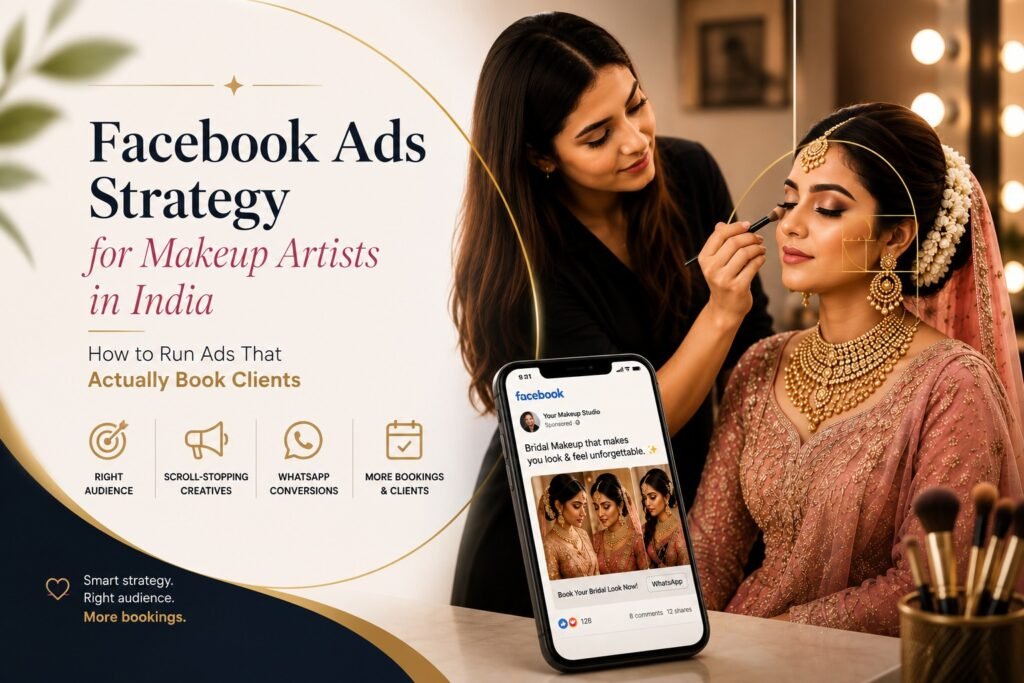
Why Facebook (and Instagram) Ads Work So Well for MUAs
Why Meta Ads Work So Well for Makeup Artists
Makeup is a highly visual service, which makes Facebook and Instagram useful platforms for showcasing your work and reaching potential clients.
Meta Ads can help you:
- Reach people in your target location
- Showcase bridal transformations and portfolio work
- Promote specific services or packages
- Generate enquiries through WhatsApp, forms or other contact options
- Reconnect with people who have already interacted with your business
- Test different creatives and audiences to understand what attracts relevant prospects
The key is to focus on relevant enquiries and bookings, rather than simply chasing impressions, clicks or followers.
A successful campaign should connect four things:
Right audience → Relevant creative → Clear offer → Easy enquiry process
Before You Spend a Rupee: Get the Foundation Right
Before You Run Meta Ads
Paid advertising works best when the basics of your business are already in place. Before launching your first campaign, make sure a potential client can easily understand who you are, what you offer and how to contact you.
Your pre-launch checklist
Professional Instagram profile
Your bio should clearly mention your speciality, location and booking method.
Strong portfolio
Show real bridal and makeup work that represents the services you want to promote.
Clear offer
Decide exactly what you’re advertising—bridal makeup, engagement makeup, party makeup or a specific package.
Easy enquiry process
Make sure potential clients can contact you through WhatsApp, a lead form, phone or your website.
Social proof
Add genuine client reviews, testimonials and client experiences wherever appropriate.
Clear service area
Know exactly which locations you are willing to serve. This helps prevent your budget from being spent on irrelevant audiences.
A way to track results
Set up appropriate conversion tracking so you can understand which campaigns are generating enquiries and bookings.
Once these basics are ready, you can start building your Meta Ads campaign.
Choosing the Right Campaign Objective
Meta simplified its ad objectives down to six under what it calls Outcome-Driven Ad Experiences: Awareness, Traffic, Engagement, Leads, App Promotion, and Sales. As a makeup artist, you’ll realistically only ever touch three of these:
- Leads — best default choice. Meta shows your ad to people likely to fill a form, message you, or click to WhatsApp, and optimizes delivery toward that specific action.
- Traffic — useful in your very first week or two if you want cheaper data and to build a retargeting audience while you’re still learning what creative works, but it optimizes for clicks, not enquiries.
- Engagement — worth using only for a specific goal, like growing comments/saves on a viral-style reel that you’ll then use as social proof — not for booking clients directly.
Avoid Awareness and Sales for now. Awareness is built for pure reach, not action, and Sales is built around e-commerce purchase events most solo MUAs and small studios don’t have the volume to feed properly.
If you’re weighing Meta ads against search intent instead, our guide to Google Ads for bridal makeup artists covers the step-by-step setup for that platform — the two work best run together rather than as a either/or choice, since Google catches people actively searching while Meta catches them while they’re still deciding.
One practical note: Meta now defaults most campaigns into its Advantage+ automated setup, which hands over a lot of the targeting and placement decisions to its algorithm. For a local service business, this isn’t necessarily bad — but you should still set the objective, location radius, and budget deliberately rather than accepting every default.
Targeting: Getting in Front of the Right Local Audience
This is where most makeup artist ad accounts leak money. A few rules that matter more than any specific interest you pick:
- Location first, interests second. Set a radius around your studio, or around the specific wedding-heavy localities you serve, before you touch anything else.
- Age range matched to reality. Bridal makeup clients in most Indian metros skew 22–34; party/festive clients run wider. Don’t default to Meta’s broadest range.
- Layer in relevant interests lightly — wedding planning, bridal wear, jewellery brands, wedding photography pages — but don’t stack five interest categories, which shrinks your audience unnecessarily.
- Build a retargeting audience from day one. Anyone who watched 50%+ of your video ad, visited your page, or messaged you but didn’t book is your warmest audience. A second, smaller-budget campaign aimed only at these people almost always converts cheaper than cold targeting.
- Use a Lookalike Audience once you have 100+ past enquiries or bookings. This is one of the highest-leverage moves available once you have that data — it tells Meta “find me more people like the ones who already booked.”
Creative That Actually Books Clients
For makeup artists specifically, three formats consistently outperform generic posts:
- Before/after transformation videos, 10–20 seconds, vertical, filmed on the client rather than staged.
- Bridal look carousels — 5–8 images from a single real bridal shoot, captioned with the package details.
- A short “meet the artist” video — even 15 seconds of you talking to camera about your process builds the trust that stock-looking ad creative can’t.
Every ad should include a clear, low-friction call to action: “WhatsApp us for your bridal trial slot” converts far better than “Learn more.” And test at least 3–4 creative variants per campaign — with a small daily budget, Meta needs volume across variants to figure out which one your audience actually responds to.
Budgets and Bidding for Small Local Businesses
You don’t need a large budget to start — you need a consistent one. A daily budget of ₹300–₹700, run for at least 5–7 days per creative test, is enough to get real signal for most single-city MUA accounts. Resist the urge to pause and restart campaigns every day or two; every restart resets Meta’s learning phase and makes your cost per result look worse than it actually is.
Split your monthly budget roughly like this once you’re past initial testing:
- 60–70% on your best-performing Leads campaign, targeted locally
- 15–20% on retargeting website/profile visitors and video viewers
- 10–15% kept aside for testing new creative or a seasonal push (wedding season, festive season)
Common Mistakes That Waste Ad Spend
- Boosting posts from the Facebook app instead of building campaigns in Ads Manager, which gives you almost no targeting or objective control.
- Sending traffic to a slow, unoptimized website instead of a one-tap WhatsApp or DM destination.
- Changing the objective or audience every 2–3 days instead of letting the learning phase settle.
- Running one single ad to “everyone in my city” instead of separating bridal, party, and academy/course enquiries into their own campaigns, since each has a different audience and message.
- No follow-up system — the ad’s only job is to start the conversation; a slow or missed WhatsApp reply is where most actual bookings are lost.
If you’ve tried ads before and they didn’t work, it’s worth ruling out the usual causes before writing off the channel — our post on why paid ads fail for most makeup artists in India breaks down the specific mistakes behind most disappointing ad results.
A Simple Starting Campaign Structure
For a solo or small-studio MUA just getting started, this structure keeps things manageable:
- Campaign 1 — Leads, Bridal: Location radius around your city, age 22–34, bridal-focused creative, WhatsApp as the destination.
- Campaign 2 — Leads, Party/Festive: Same setup, wider age range, party-look creative, run heavier around festive and event season.
- Campaign 3 — Retargeting: Small budget, targeted only at people who engaged with Campaigns 1 and 2 but haven’t messaged yet.
Review cost per enquiry weekly, not daily, and only make one change at a time — either the creative, the audience, or the budget — so you can actually tell what moved the needle.
FAQs
Most solo or small-studio MUAs see workable results starting around ₹8,000–₹15,000/month, split across a local Leads campaign and a smaller retargeting campaign, before scaling up what’s working.
You don’t have to choose — a single Meta campaign runs across both. In practice, Instagram placements usually drive more engagement for visual bridal/beauty content, while Facebook often pulls in an older, sometimes higher-budget client base.
For most MUAs starting out, a WhatsApp click-to-chat destination converts better because it removes every extra step between “interested” and “talking to you.” A landing page becomes worth building once you’re running higher volume and want to pre-qualify enquiries (budget, date, location) before the chat starts.
Yes, but treat it as a separate campaign with its own audience — academy leads are typically aspiring artists searching for courses and certification, a different intent and age group than bridal or party clients.
FEELING COMPLICATED?
Don’t worry, you don’t have to do it alone. From choosing the right campaign objective and audience to creating ads, tracking results and optimising your campaigns, our team at KOLKATA DIGITAL can help you build and manage a strategy that works for you.
Contact us now for a consultation.