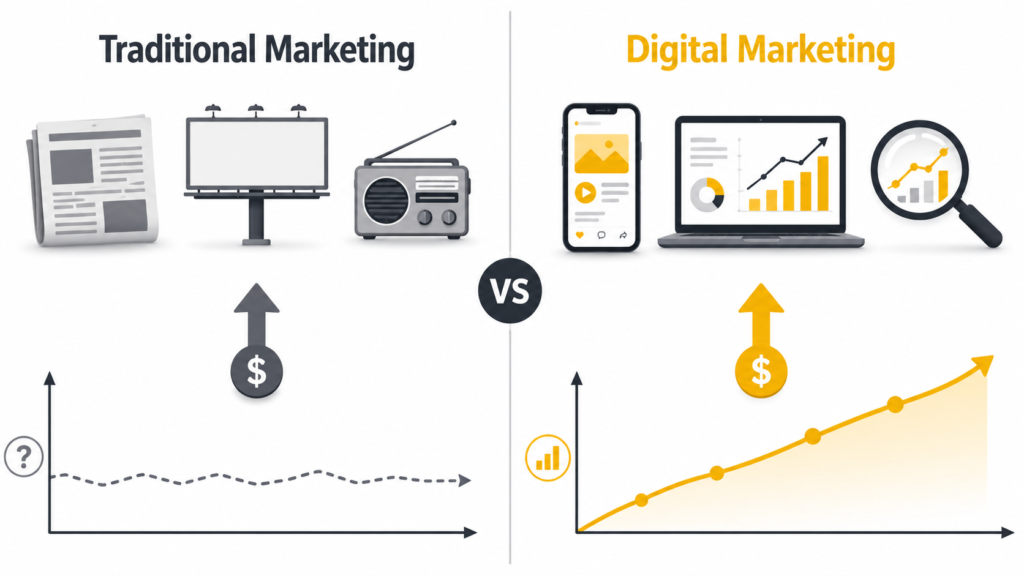
Digital marketing uses online channels like search, social media, and email to reach customers with measurable, trackable results, while traditional marketing uses offline channels like TV, print, radio, and billboards to build broad awareness without precise tracking. For most small and local businesses in 2026, digital marketing delivers a more cost-efficient and accountable return — but traditional marketing still has a role in building broad local trust, especially for certain audiences and industries.
If you’ve already read our guide on what digital marketing is, this page goes deeper into exactly how it compares to the offline methods businesses have relied on for decades.
Last updated: June 2026
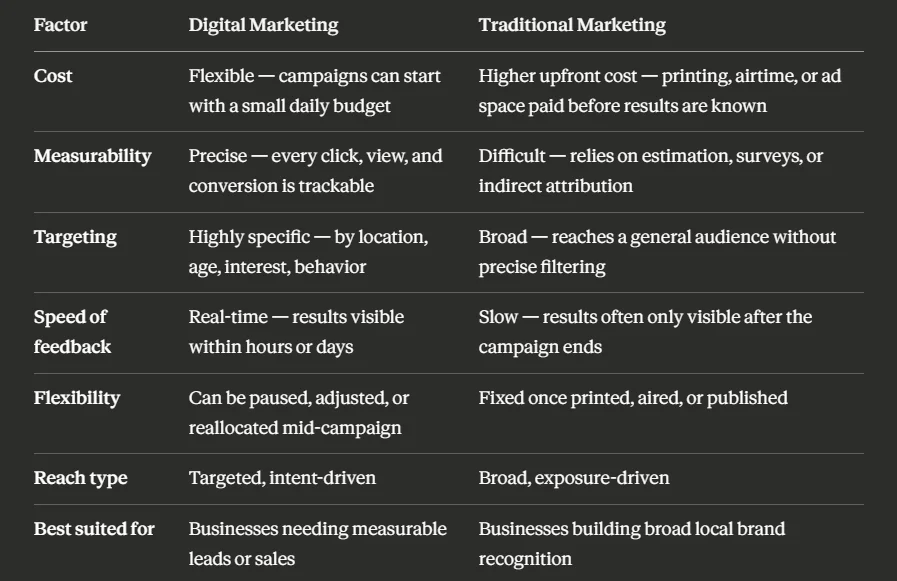
Digital Marketing vs Traditional Marketing: Side-by-Side Comparison
Cost Comparison: Digital vs Traditional Marketing
The biggest practical difference business owners notice first is cost structure, not just cost amount.
Traditional marketing requires upfront, fixed spending. Printing flyers, buying a newspaper ad slot, or booking radio airtime means paying the full cost before knowing whether it worked. If the offer or message doesn’t land, that spend is already gone.
Digital marketing allows spending to scale with results. A Google Ads or Facebook Ads campaign can be tested with a small daily budget, monitored closely, and adjusted or paused based on real performance — rather than committing a large amount upfront on a guess.
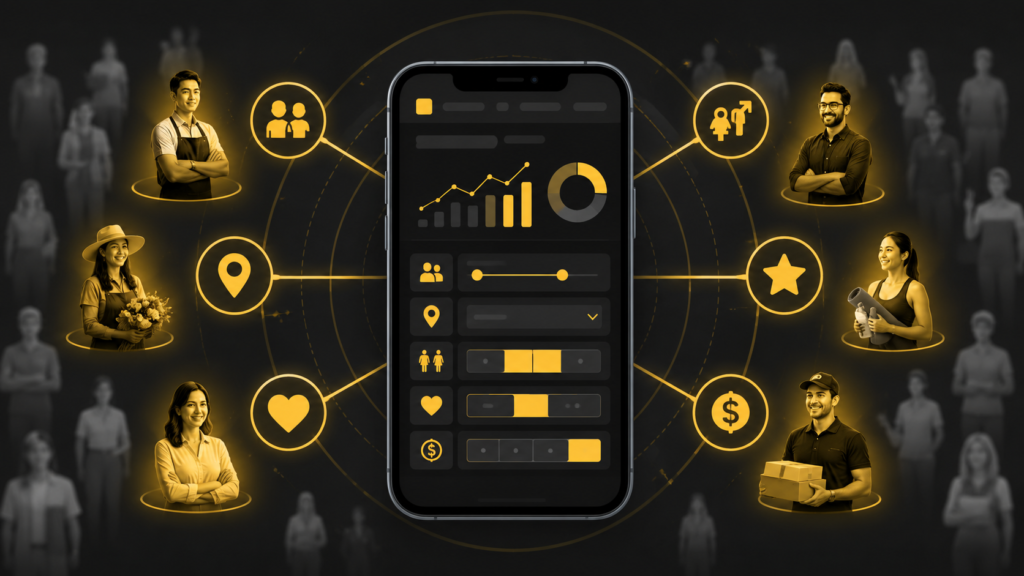
In the Indian market specifically, this difference is significant for small businesses: traditional marketing typically generates approximately ₹150–400 in revenue for every ₹100 spent, though tracking this precisely is rarely possible, while digital marketing budgets make ROI tracking far more transparent. A targeted Facebook or Instagram ad campaign can start at ₹300–500 per day, with the ability to target by age, gender, location, interests, income bracket, and purchase behavior — a level of targeting traditional marketing simply cannot offer.
Which Has Better ROI — Digital or Traditional Marketing?
Digital marketing generally delivers more measurable and often higher ROI than traditional marketing, primarily because of how precisely it can be tracked.
Why traditional marketing’s ROI is hard to verify: When someone visits a store after seeing a billboard or hearing a radio spot, there’s usually no direct way to attribute that visit to the specific ad — businesses typically rely on estimations, customer surveys, or year-over-year comparisons to gauge effectiveness.
Why digital marketing’s ROI is easier to prove: Every click, form fill, and sale from a digital campaign can be traced back to the exact ad, keyword, or post that drove it, using tools like Google Analytics or Meta Ads Manager. Most digital marketers strive for an average ROI of 5:1 — five dollars in revenue gained for every one dollar spent — which is considered slightly above average by industry benchmarks, with exceptional results reaching 10:1 or higher.
This doesn’t mean every digital campaign automatically outperforms every traditional one — a poorly targeted Google Ads campaign can still waste money. But the ability to see what’s working and fix it mid-campaign is the structural advantage digital holds that traditional marketing cannot match.
When Traditional Marketing Still Makes Sense
Despite digital’s measurability advantage, traditional marketing isn’t obsolete. It still works well for:
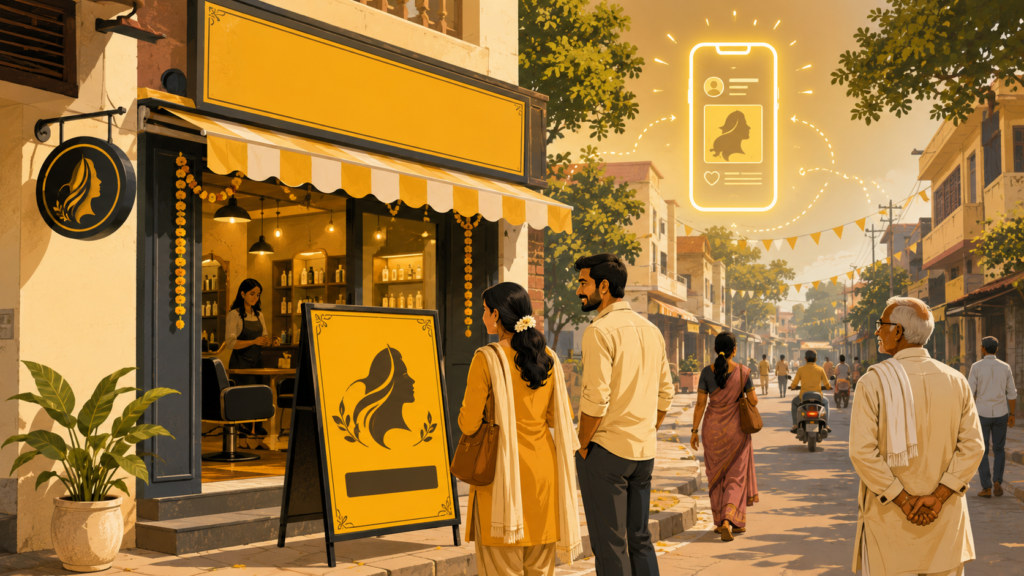
- Hyperlocal, walk-in-driven businesses (a salon relying on neighborhood visibility, a local restaurant) where a hoarding or local newspaper ad reaches the exact nearby audience
- Building broad trust quickly — a billboard or TV spot can convey scale and credibility that a small Instagram page hasn’t built yet
- Audiences with lower digital engagement — certain older or rural demographics may still respond better to print, radio, or in-person promotion
- Brand reinforcement alongside digital — many businesses use both together, for example a banner outside a shop that reinforces the same message running in their Google Ads
The realistic answer for most small businesses isn’t “pick one” — it’s using digital marketing as the primary, measurable engine for leads and sales, while keeping a light traditional presence (signage, local print) where it still adds value.
Is Online Marketing the Same as Digital Marketing?
Yes — for practical purposes, online marketing and digital marketing are used interchangeably, and the comparison above applies equally to both terms. Technically, online marketing refers specifically to internet-based channels, while digital marketing is the slightly broader umbrella that also includes things like SMS marketing or digital billboards. For a small business deciding how to spend a marketing budget, this distinction rarely changes the decision — the channels in question (search, social, email, ads) are the same either way.
We cover this terminology distinction in more detail in our main digital marketing guide.
Is Internet Marketing the Same as Digital Marketing?
Yes, in the same way — internet marketing is essentially another name for the online portion of digital marketing. Some older sources use “internet marketing” specifically for web-based promotion (websites, search engines, email) and reserve “digital marketing” for anything that uses digital technology, including channels like SMS or digital TV ads. In current usage, especially in India, the three terms — digital marketing, online marketing, and internet marketing — are treated as synonyms in almost all everyday and business contexts.
Frequently Asked Questions
For most small and local businesses in 2026, digital marketing offers better measurability and more efficient budget control. Traditional marketing still has value for hyperlocal trust-building and reaching audiences with lower digital engagement.
Often yes — digital marketing allows flexible, scalable budgets starting from a small daily spend, while traditional marketing typically requires a larger fixed cost paid upfront before results are known.
The main difference is measurability. Digital marketing can be tracked precisely — clicks, conversions, and costs are visible in real time — while traditional marketing relies on estimation and indirect attribution.
Not in any way that matters practically — the two terms are used interchangeably. Online marketing is technically a subset of digital marketing, but the channels and strategies involved are the same.
Many businesses benefit from combining both — using digital marketing as the primary measurable channel for leads and sales, while keeping a light traditional presence like local signage for broad visibility.
Not sure which mix is right for your business? Get in touch with Kolkata Digital for a strategy built around your specific budget and goals.