
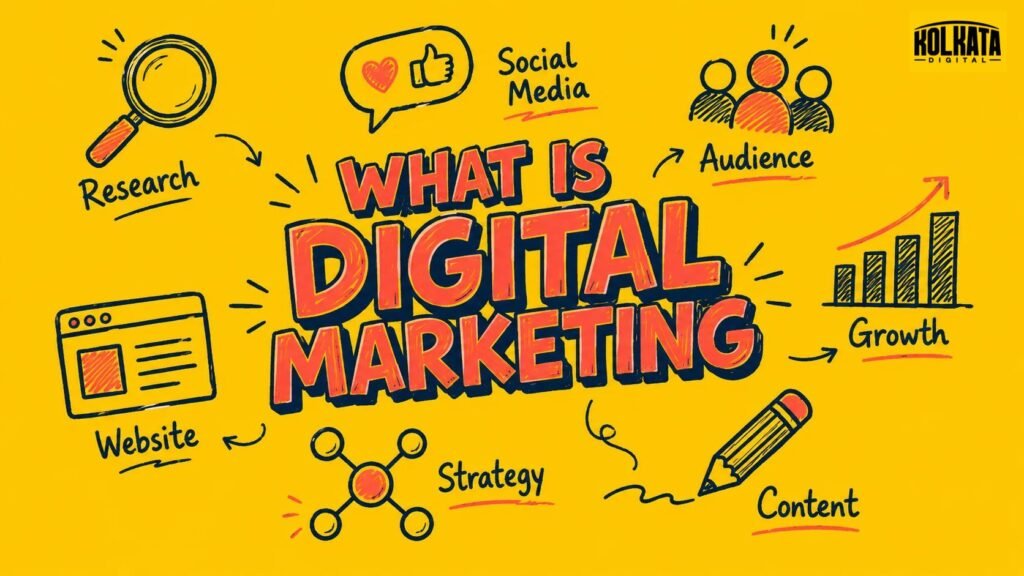
If you’ve ever searched for a business on Google, discovered a brand on Instagram, read online reviews before making a purchase, or clicked on an advertisement while browsing the internet, you’ve already experienced digital marketing.
Simply, digital marketing is the process of promoting a business, product or service through digital channels such as search engines, websites, social media, email and online advertising.
But digital marketing is much more than posting on Instagram or running Google Ads. A successful digital marketing strategy helps a business get discovered, build trust, generate enquiries and turn potential customers into paying customers.
In this guide, we’ll explain what digital marketing means, how it works, the different types of digital marketing, why it matters for businesses, and how you can build a practical digital marketing strategy.
Last updated: June 2026
Is Digital Marketing the Same as Online Marketing?
Yes, in everyday use — “digital marketing” and “online marketing” mean the same thing. Technically, digital marketing is the broader umbrella term that includes online marketing (anything done via the internet) as well as offline digital channels like SMS marketing or digital billboards. Online marketing is a subset of digital marketing that happens specifically through the internet.
For most small businesses, this distinction doesn’t matter day-to-day — the channels you’ll actually use (SEO, social media, Google Ads, email) fall under both terms equally.
How Does Digital Marketing Work?
Digital marketing works by meeting potential customers on the platforms they already use — search engines, social media, their inbox — and guiding them toward a decision, using data to constantly improve the approach.
At a basic level, the process looks like this:
- A business identifies its target audience — who they are, what they search for, where they spend time online.
- It creates content or ads designed to reach that audience on relevant channels (a blog post for Google search, a reel for Instagram, an ad for Google Ads).
- The audience engages — clicks a link, visits a website, fills a form, or makes a purchase.
- The business measures the result using tools like Google Analytics or Meta Ads Manager — what worked, what didn’t.
- The strategy is adjusted based on that data, and the cycle repeats.
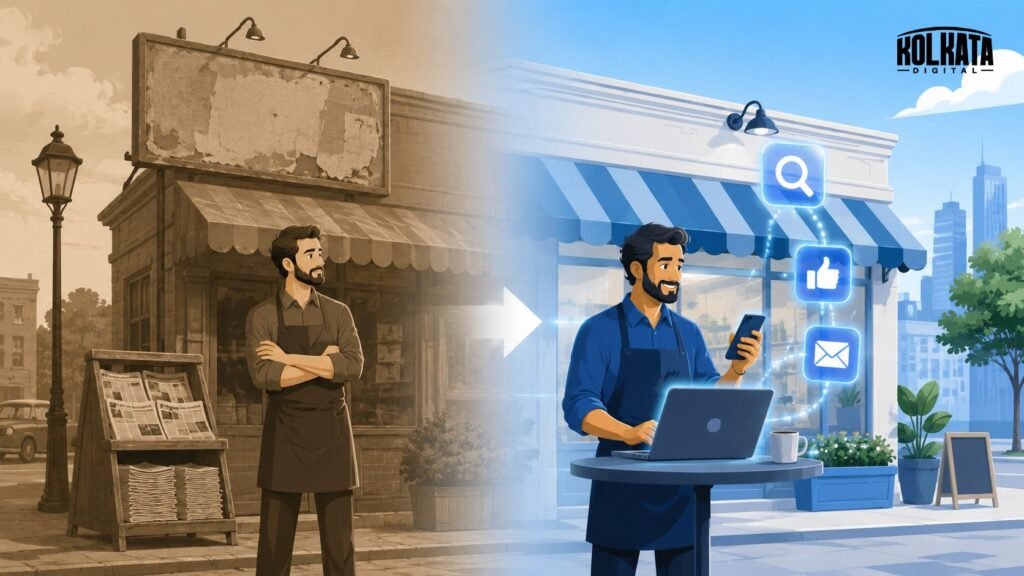
This is the biggest practical difference from a newspaper ad or a hoarding: a digital campaign tells you exactly how many people saw it and what they did next, so it keeps getting better instead of just running blind.
7 ways of Digital Marketing
Digital marketing isn’t one activity — it’s a set of channels that work together. Here are the main types, with real examples of what each looks like in practice.
Search Engine Optimization (SEO)
Improving a website so it shows up naturally (without paying) in Google search results. Example: a salon’s blog post ranking for “bridal makeup artist in Kolkata” without running any ads.
Search Engine Marketing / PPC (Pay-Per-Click)
Paying to appear at the top of search results, charged each time someone clicks. Example: a Google Ads campaign that shows up instantly for “makeup artist near me” while the SEO ranking is still being built.
Social Media Marketing
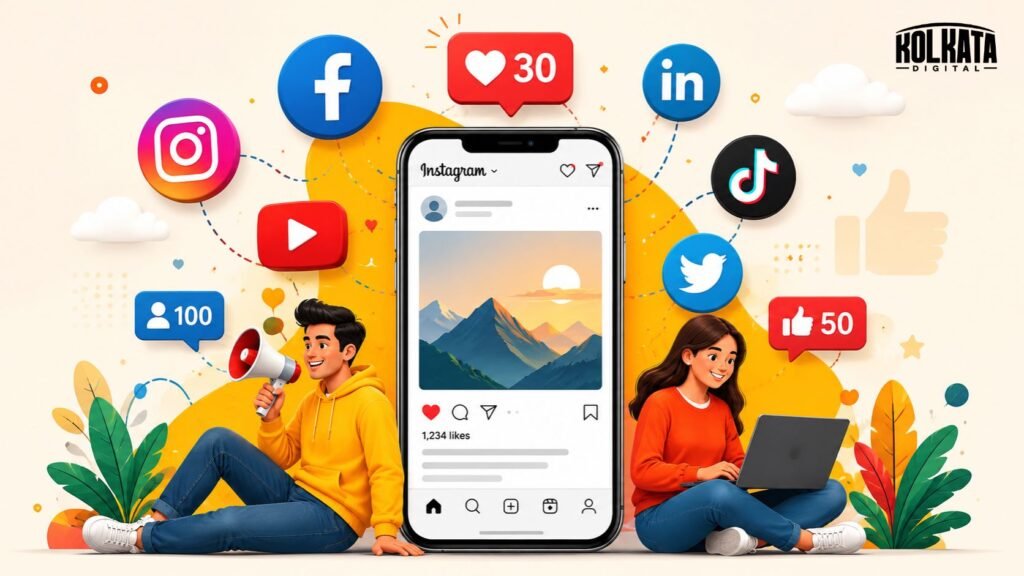
Using platforms like Instagram, Facebook, and LinkedIn to build awareness and engage an audience. Example: a makeup studio posting before/after transformation reels to attract bridal clients.
Content Marketing
Creating useful content (articles, videos, guides) that attracts an audience and builds trust over time, rather than asking for a sale immediately. Example: a “how to choose a bridal makeup artist” guide that ranks in search and slowly builds inquiries.
Email Marketing
Sending messages directly to people who’ve already shown interest, used for nurturing leads and retaining existing customers. Example: a follow-up email to someone who enquired but didn’t book yet.
Affiliate & Influencer Marketing
Partnering with other people or accounts who promote a product to their own audience for a commission or fee. Example: a local beauty influencer reviewing a salon’s services for their followers.
Google Business Profile (Local SEO)
Optimizing a free Google listing so a business shows up on Google Maps and local search results. Example: a salon appearing in the local map results when someone searches “salon near me.”
The 4 Stages of a Digital Marketing Strategy
A working digital marketing strategy generally moves through four stages, repeated continuously:
| Stage | What Happens |
| 1. Strategic planning & audience definition | Define clear goals (more traffic, more leads, more sales) and understand who the target audience actually is — their behavior, needs, and where they spend time online. |
| 2. Channel selection & execution | Choose the right mix of channels (SEO, ads, social, email) based on the audience and budget, then build and launch the campaigns. |
| 3. Measurement | Track results using analytics tools — clicks, conversions, cost per lead, return on ad spend. |
| 4. Testing & iteration | Adjust targeting, creative, or budget based on what the data shows, then repeat the cycle. |
This is what separates digital marketing from a one-time print ad: it’s a continuous, data-driven loop, not a single action.
Why Does Digital Marketing Matter for a Business?
Digital marketing matters because it lets a business reach customers where they already spend the most time — online — while being able to measure and improve results in a way traditional marketing simply can’t.
For small and local businesses specifically, this means:
Measurable ROI — knowing exactly what a customer cost to acquire, and whether the spend is working
Lower entry cost compared to TV, print, or hoardings
Precise targeting — reaching only the people likely to actually want the service, by location, interest, or search behavior
Two-way communication — customers can ask questions, leave reviews, and engage directly, instead of just receiving a message
Frequently Asked Questions
Digital marketing is using the internet — like Google, social media, and email — to find and convert customers, instead of relying only on traditional offline advertising.
In practice, yes — the terms are used interchangeably. Technically, online marketing is a subset of the broader category of digital marketing.
The main types are SEO, paid search (PPC), social media marketing, content marketing, email marketing, affiliate/influencer marketing, and local SEO via Google Business Profile.
Digital marketing is measurable and two-way — you can track exactly who engaged and adjust in real time. Traditional marketing (TV, print, billboards) is one-way and much harder to measure precisely.
A website helps but isn’t always required to start — channels like Google Business Profile, Instagram, or Facebook can be used on their own, especially for local service businesses just getting started.
NOT SURE HOW TO START?
Don’t worry, you don’t have to figure it all out alone. Kolkata Digital can help you choose the right digital marketing strategies for your business and build a stronger online presence.
Get in touch with us today for a consultation.
=