
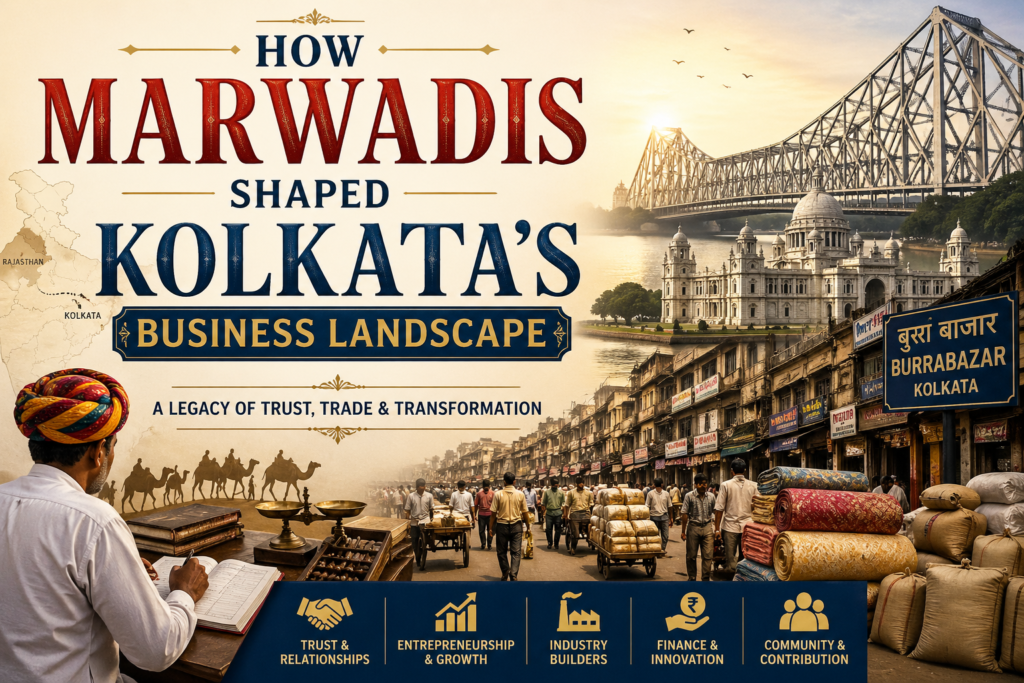
Walk through the busy streets of Kolkata, and you’ll quickly realize that business is not just an activity here—it’s a way of life. From crowded markets to towering corporate offices, the city breathes commerce. Behind much of this energy is a community that quietly but powerfully shaped its economic backbone—the Marwadis.
Originally from Rajasthan, Marwadis didn’t just come to Kolkata to do business—they built systems, relationships, and legacies that still define how trade works in the city today.
A Journey Driven by Opportunity
The story begins centuries ago, when Kolkata was rising as a major trading hub under the British East India Company. For many Marwadi families living in the harsh, dry regions of Rajasthan, this presented a rare opportunity.
Imagine leaving your home, traveling across the country with limited resources, and starting from scratch in a completely new environment. That’s exactly what many Marwadis did. They began as small traders, moneylenders, and middlemen—taking risks, building trust, and slowly carving a space for themselves in an unfamiliar city.
What set them apart wasn’t just business skill—it was patience and persistence.
Burrabazar: Where It All Came Together
If you want to truly understand Marwadi influence in Kolkata, spend a day in Burrabazar. It’s chaotic, loud, and endlessly busy—but beneath that chaos lies a deeply organized system built over generations.
Here, business isn’t done with flashy presentations or complex contracts. It runs on trust, relationships, and reputation. Deals are often sealed with a handshake, and a person’s word carries weight.
Many Marwadi families started with tiny shops in Burrabazar. Over time, those small setups grew into large trading houses. What’s fascinating is how these businesses stayed within families, with knowledge passed from one generation to the next—almost like a living classroom of entrepreneurship.
From Small Traders to Industry Leaders
Not every story stayed small. Some Marwadi entrepreneurs went on to build massive business empires that shaped not just Kolkata, but all of India.
Take Ghanshyam Das Birla, for example. Starting from humble beginnings, he went on to create one of India’s biggest industrial groups. His journey reflects a larger pattern—thinking big, even when starting small.
Similarly, leaders like R.P. Goenka expanded into diverse industries, from power to retail. Their businesses created jobs, boosted infrastructure, and helped position Kolkata as a serious economic powerhouse.
These weren’t just businessmen—they were builders of modern industry.
A Different Way of Doing Business
One of the most interesting aspects of Marwadi success is how they approach money and finance.
Long before modern banking became widespread, they relied on systems like “hundi”—a trust-based method of transferring money. It worked because relationships mattered more than paperwork.
Even today, many Marwadi businesses operate on core principles like:
- Spend carefully
- Save consistently
- Reinvest wisely
- Think long-term
It’s simple advice, but incredibly powerful—and it’s one of the reasons their businesses have survived for generations.
Beyond Profit: Giving Back to the City
What often goes unnoticed is how much the Marwadi community has given back to Kolkata. Their success wasn’t just about building wealth—it was also about creating impact.
Across the city, many schools, hospitals, and charitable institutions have been supported by Marwadi families. This sense of responsibility comes from a belief that business success should benefit society as well.
Over time, they didn’t just live in Kolkata—they became a part of its social and cultural fabric.
The New Generation: Blending Tradition with Change
Today, things are changing—but not disappearing.
Younger Marwadis in Kolkata are stepping beyond traditional businesses. Many are entering startups, tech companies, finance, and even global markets. They’re more experimental, more digital, and more open to new ideas.
But here’s the interesting part—they still carry the same core values:
discipline, resilience, and a strong business mindset.
It’s this balance between tradition and innovation that keeps the community relevant even today.
The story of Marwadis in Kolkata isn’t just about business—it’s about courage, adaptation, and long-term thinking.
They arrived as outsiders, started small, faced challenges, and slowly built something extraordinary. Today, their influence is everywhere—from local markets to large corporations.
Kolkata’s business landscape wouldn’t be what it is without them. And perhaps the biggest lesson they leave behind is this: success isn’t built overnight—it’s built over generations, with trust, discipline, and vision.