
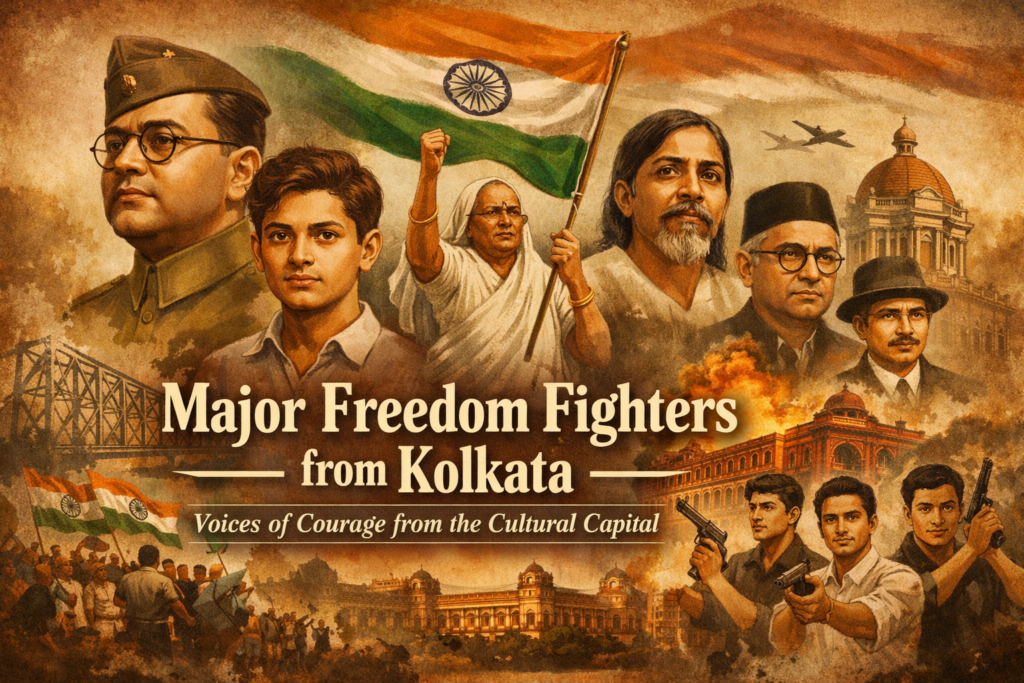
Kolkata, once the capital of British India, was far more than an administrative center—it was the intellectual and revolutionary heartbeat of the Indian freedom movement. The city gave rise to thinkers, leaders, and fearless revolutionaries who challenged colonial rule through ideas, action, and sacrifice.
From political leadership to armed rebellion, the freedom fighters associated with Kolkata played a defining role in India’s struggle for independence. Their stories are not just historical accounts—they are powerful reminders of courage and conviction.
The Rise of Revolutionary Spirit in Kolkata
Kolkata became a center of resistance due to its strong educational institutions, vibrant press, and politically aware youth. The city fostered both intellectual debate and underground revolutionary movements.
Secret societies, student activism, and nationalist writings created an atmosphere where resistance against British rule became inevitable. It was in this charged environment that some of India’s greatest freedom fighters emerged.
Subhas Chandra Bose: The Face of Bold Nationalism
One of the most influential leaders of the freedom movement, Subhas Chandra Bose had a deep connection with Kolkata. His early education in the city exposed him to nationalist ideas that shaped his future path.
Unlike many leaders, Bose believed that independence required direct and forceful action. As the leader of the Indian National Army (INA), he sought to overthrow British rule through military means. His famous call, “Give me blood, and I will give you freedom,” inspired millions across the country.
Kolkata was not just his hometown—it was the foundation of his revolutionary ideology.
Aurobindo Ghosh: The Intellectual Force Behind Nationalism
Before becoming a spiritual philosopher, Aurobindo Ghosh was one of the strongest voices of early nationalism. During his time in Kolkata, he actively participated in revolutionary activities and used journalism as a powerful tool to awaken political consciousness.
Through his writings in nationalist newspapers, he advocated complete independence at a time when many leaders were still seeking reforms under British rule. His contribution highlights how ideas and intellect played a crucial role in shaping the freedom movement.
Youth Revolutionaries: Khudiram Bose and Prafulla Chaki
The courage of Bengal’s youth became a defining feature of the freedom struggle. Khudiram Bose and Prafulla Chaki symbolize this fearless spirit.
Their attempt to assassinate a British official in 1908 marked one of the earliest revolutionary actions against colonial rule. Although the mission did not succeed as planned, Khudiram’s execution at just 18 years old turned him into a national hero.
His bravery demonstrated that even the youngest citizens were ready to sacrifice their lives for independence.
The Writers’ Building Attack: A Symbol of Defiance
One of the most dramatic events in Kolkata’s revolutionary history was the attack on the Writers’ Building—the center of British administration.
This bold act was carried out by:
- Binoy Basu
- Badal Gupta
- Dinesh Gupta
Their mission was to challenge colonial authority directly. Though they ultimately sacrificed their lives, their actions sent a powerful message: the British were not invincible.
Chittaranjan Das: The Voice of Political Leadership
Not all freedom fighters chose the path of armed resistance. Chittaranjan Das, popularly known as Deshbandhu, represented the political and constitutional struggle for independence.
A respected lawyer and leader, he played a key role in the Non-Cooperation Movement and later founded the Swaraj Party. He also mentored Subhas Chandra Bose, guiding him in his early political journey.
Das believed in self-governance and worked tirelessly to unite people across communities in the fight against British rule.
Women in the Freedom Struggle: Matangini Hazra
The contribution of women in the freedom movement is often overlooked, but figures like Matangini Hazra prove otherwise.
Even in her seventies, she actively participated in protests during the Quit India Movement. She was shot while leading a procession but continued chanting “Vande Mataram” until her last breath.
Her story reflects the inclusive nature of the struggle, where courage knew no boundaries of age or gender.
Rash Behari Bose: The Global Revolutionary
Rash Behari Bose extended the influence of Bengal’s revolutionary movement beyond India. Though much of his work took place abroad, his roots were deeply connected to Bengal’s political climate.
He played a crucial role in organizing revolutionary networks and later contributed to the formation of the Indian National Army, which was eventually led by Subhas Chandra Bose.
His efforts highlight the international dimension of India’s fight for independence.
Why Kolkata Became a Hub of Freedom Fighters
Kolkata’s unique combination of intellectual culture and political awareness made it a breeding ground for revolutionaries.
- Strong educational institutions encouraged critical thinking
- Newspapers and literature spread nationalist ideas
- Youth participation fueled revolutionary movements
- Both violent and non-violent resistance coexisted
This dynamic environment allowed multiple forms of resistance to grow simultaneously.
A Legacy of Courage and Sacrifice
The freedom fighters associated with Kolkata were more than historical figures—they were symbols of resistance, determination, and vision.
From the militant leadership of Subhas Chandra Bose to the intellectual influence of Aurobindo Ghosh, from the youthful bravery of Khudiram Bose to the political wisdom of Chittaranjan Das, each contributed uniquely to India’s independence.
Their legacy continues to inspire generations, reminding us that freedom was not granted—it was earned through immense sacrifice.
Kolkata remains a living testament to this legacy—a city where revolution was not just an act, but a way of life.